






How Pubs, Campuses and Tech Money Shaped Bengaluru’s Live Music Scene
Bengaluru is considered India’s live music capital because three things arrived together: a
dense pub and gig circuit, a young tech workforce with money and late evenings to
spend, and decades of rock and indie culture that taught audiences to expect quality. The
result is a crowd that listens closely and judges quickly.
Here is the oddity. Bengaluru is a city of software parks, long meeting days and engineers who talk about sprints, not setlists. Yet it is routinely described as India’s pub and rock capital, and the label has real history
behind it.
The label is also less settled than the legend suggests. Homegrown’s account of the city’s
rock years notes that Bengaluru held the “rock capital of India” title for a long time before
Shillong overtook it. So this is not the story of an unbroken crown. It is the story of a city
that built a habit, going out to hear live music on an ordinary evening, and then kept
rebuilding that habit each time something knocked it down.
That habit matters well beyond nightlife. If you are programming an evening for a few
hundred employees in a Bengaluru ballroom, many of them walk in carrying it. This piece
traces where the habit came from and what it means for the people in your room.
Where did Bengaluru’s live-music culture come from?

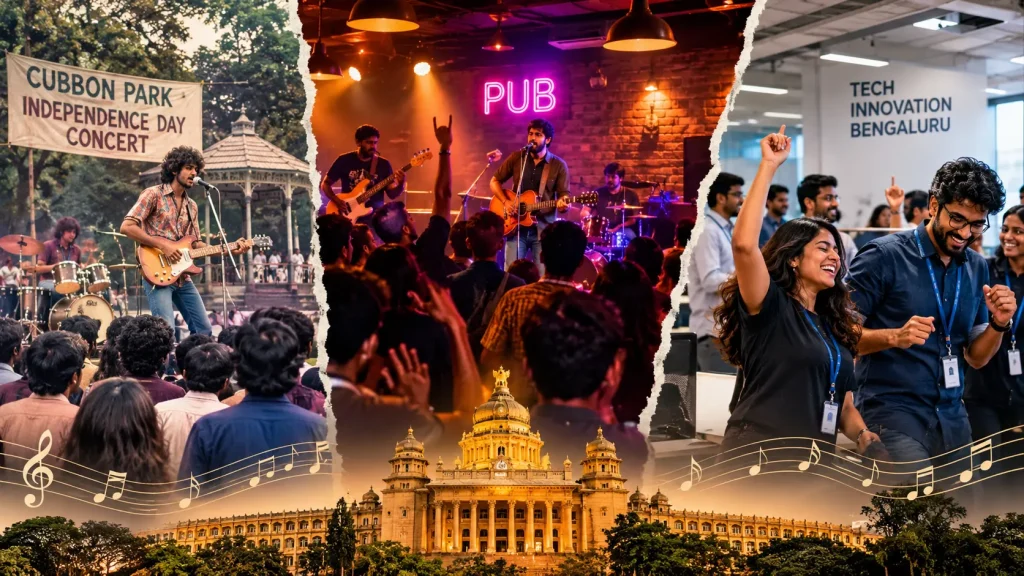
It did not start in a pub. According to a 2008 Citizen Matters feature on the city’s bands,
rock in Bengaluru began in the 1970s, when a pioneering group played English-language
hits at Cubbon Park on Independence Day. The performance drew criticism, and it also
sparked a movement. A 2022 News Minute retrospective on the 1960s and 70s paints the
same early picture: small, informal pop shows at clubs and parties, young players on
acoustic guitars, and a repertoire borrowed from the Beatles, the Ventures and the
Rolling Stones.
The pubs arrived next, and they brought the audience with them. Business Today’s
December 2007 look at Bangalore’s pub culture describes the first pubs as places that
put draught beer and good music ahead of style, with pub-hopping going into high gear in
the 1990s. Homegrown adds the geography: after independence, the Cantonment area
around MG Road and Brigade Road filled with pubs, nightclubs and bars. By 2007,
Business Today counted more than 1,000 bars and pubs in the city.
Then came the money, and the clock. The same article credits Bangalore’s shift from a
“pensioner’s paradise” to India’s IT capital with the spending power that kept the scene
going, and notes that late-working professionals often had about an hour after work to
spend in a pub. A workforce with disposable income and a habit of staying late landed in a
city that already had somewhere to go. Citizen Matters adds an irony: many of the
musicians were part of that workforce too, playing in bands alongside IT, BPO or call
centre jobs.
The third strand is the campus circuit. Homegrown’s 2021 piece on college festivals
describes them as “a road to bigger things” for Indian bands, and names Strawberry Fields
at the National Law School in Bengaluru among the best-remembered events. Citizen
Matters points to the 1999 edition of that event, where a Bengaluru folk-rock frontman
finished as runner-up, as one early stepping stone.
Pub floor, campus stage and office desk: three rooms, one audience.
What does a gig-literate audience expect?

Think of it as a crowd that has heard a lot of live music and has opinions about it. Three
expectations come up again and again when people write about Bengaluru audiences.
The first is originality, with room for the familiar. Citizen Matters argued in 2008 that cover
sets draw a crowd quickly but lose it just as fast, because audiences move on to the next
cover band, while original songs take longer to land and build lasting fans. By 2021,
Homegrown reported that college crowds wanted original music, high energy, sing-along
moments and multilingual or fusion sets. The pattern is: surprise me, but let me join in.
Tribute acts show the other side of the same coin. An August 2026 Homegrown report
says tribute shows have become the financial backbone of many Indian live venues
because audiences reliably turn out for familiar catalogues.
The second is quality. A musician quoted by Deccan Herald described Bengaluru’s
audience as culturally educated and deserving of good entertainment. A crowd with that
history can tell a tight, well-balanced set from a loose one within a song or two, and it is
not shy about showing it.
The third is pacing. A good set reads the room: when to hold back, when to build, when to
hand the chorus to the crowd. It is the difference between a set that feels short and one
that merely ends.
Scarcity sharpened all of this. In June 2018, The News Minute reported that 27 Bengaluru
establishments had been shut for playing live music without a licence, under a 2005 order
on places of public entertainment that the Supreme Court had upheld that January.
Deccan Herald’s later reporting says closures in 2018 and 2019, followed by the pandemic, thinned out the small venues where original acts once played. Smaller rentable spaces
have since appeared, and the recovery is described as real but slow. When live music is
harder to find, people treat it as an occasion, not as background.
How is a corporate crowd different from a club crowd?
A club crowd chose the night. They paid, they came for the act or the room, and they can
walk out. A corporate crowd was invited by a calendar. Some are delighted, some are tired,
some are quietly working out the cab home, and the most senior person present may be
standing next to the buffet. Three differences follow.
The first is the mix. A club has a taste profile. A company has a payroll: interns to
leadership, several mother tongues, and often nothing in common except the logo on the
lanyard. Language is the hardest part of that mix to get right, and it deserves its own plan.
Language is the hardest part of
that mix to get right, and we have written about
how to host events across Kannada,
English or both.
The second is the reason for being there. Employees came for the occasion, not the artist,
so the first ten minutes decide whether the music becomes the event or the wallpaper.
The third is comfort. It is a weeknight, the working day is behind them, and many are still
in office clothes. Whether people are standing with a drink or seated for dinner changes
what will work, from volume to song choice.
Where do the two crowds meet? In the things the gig scene already rewards: a chorus the
room can join, a set that builds instead of shouting, and sound that does not push people
to the edges of the hall. A Bengaluru company audience contains many people who have
stood at those gigs on other nights. When the music respects them, the room warms up
the way a club crowd does, only usually a little faster than anyone expected.
What does Bengaluru’s gig culture mean for company events?

The lesson is not “get the loudest act”. It is that a Bengaluru company evening is judged by
listeners, so it should be programmed for listening.
Start with the room, not the act. A standing mixer and a seated dinner call for different
sets, different volumes and different openings. Programming live music for Bengaluru corporate audiences works best when the shape of the evening is settled first: a gentle
opening while people arrive, a build, one moment where the whole room sings, and a clean
finish. For a wider view of the formats that suit companies, the national category of
live bands and singers for corporate events shows the range.
Balance the familiar with something fresh, because the writing on this scene keeps
landing on the same mix: songs people can join, played by musicians who clearly mean
them. Think about language early too. A Bengaluru room rarely shares one, and a set that
moves across Kannada, Hindi, English and regional favourites includes more people than
one that stays in a single lane.
Finally, talk to the venue about space, sound limits and any permissions needed for live
music. The 2018 crackdown is a reminder that rules apply even when the intent is entirely
innocent, and a conversation in week one is far cheaper than a problem on the night.
Bengaluru spent decades teaching its audiences what good live music sounds like. The
companies that do well here simply plan as though the audience already knows.
Planning an event in Bengaluru?
If you are planning an event in Bengaluru, the engage4more Bengaluru team can help you
think through the music, the room and the language mix. A good place to start is
Bengaluru’s live-music line-up.
FAQs
Q. Why is Bengaluru called the pub capital of India?
Bengaluru built its pub reputation from the 1980s and 1990s, as a growing IT workforce
with spending power and late working hours filled the Cantonment area’s pubs. Business
Today counted more than 1,000 bars and pubs in the city by 2007. The label is a popular
description, not an official title.
Q. Do Bengaluru audiences prefer original or cover music?
It depends on the room. Local bands have long used covers to draw crowds quickly, but
writers on the scene argue that originals build lasting fans, and college audiences are
reported to expect original, sing-along and multilingual sets. Tribute shows still sell well
across Indian cities, so familiar songs keep a strong pull.
Q. How has the live scene changed after the pandemic?
Deccan Herald reports that Bengaluru’s venues are recovering slowly after closures in
2018 and 2019 hit the scene before the pandemic did. Smaller rentable spaces have
emerged to fill gaps, while some larger venues ask bands to sell a minimum number of
tickets. The recovery is real but uneven.
Q. Why does Bengaluru’s gig culture matter for company events?
In a city with this gig history, employees tend to arrive with club-level expectations of
sound, pacing and originality. Programming for listeners rather than background noise is
the safest way to meet them, with a mix of familiar songs and fresh material that suits the
room, the hour and the languages present.