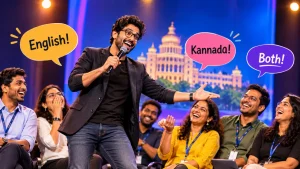





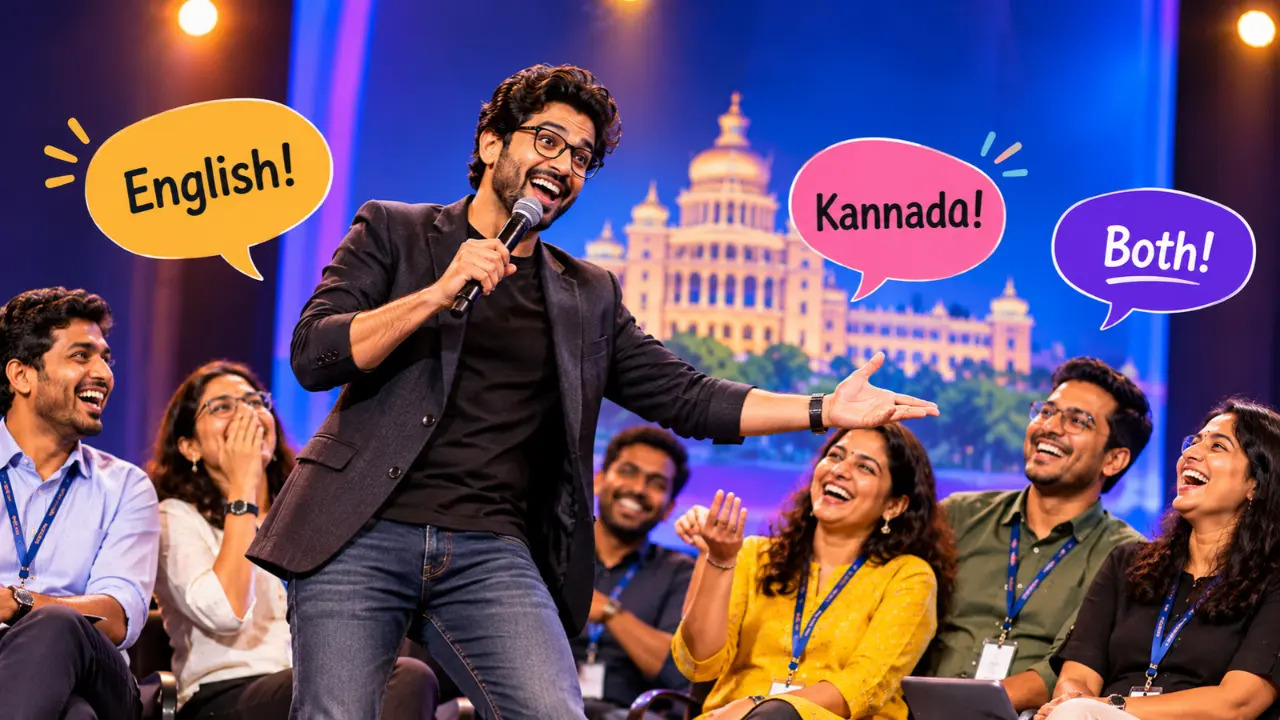
Multilingual Corporate Events in Bengaluru: Keeping the Whole Room Laughing
How should multilingual corporate events in Bengaluru be hosted? Most mixed
workplaces run best with English as the working language, a few deliberate lines in
Kannada, and a clear plan for the other languages in the room. The right mix depends on
who is actually attending, so decide it from the audience, not from habit.

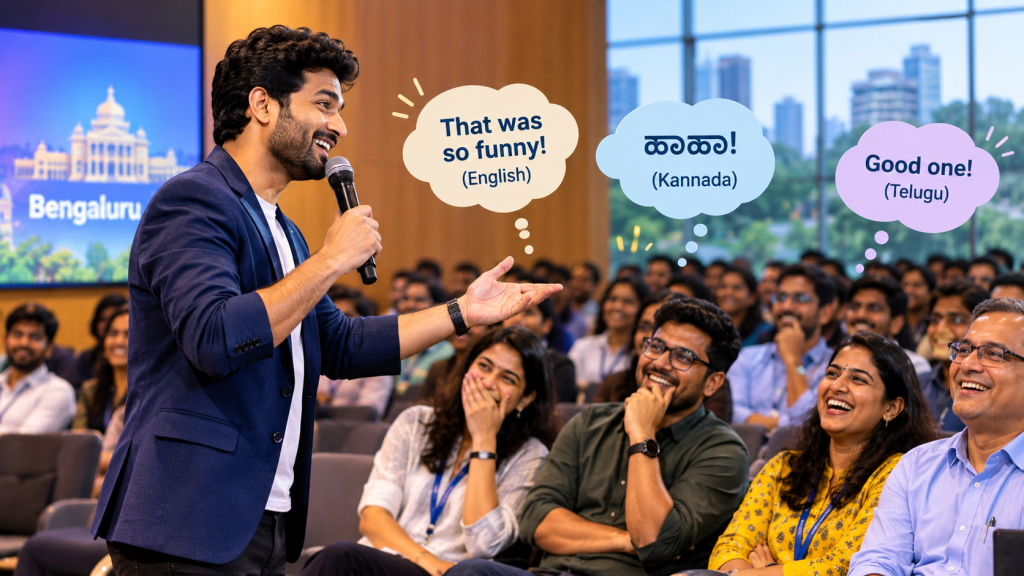
Picture a 6:30 pm town hall on a Bengaluru campus. The host lands a joke in crisp English.
Part of the room laughs on cue. Another part laughs a beat later, once the line has finished
translating itself in their heads. The rest smile politely and check the time. Nobody did
anything wrong, and the joke was good. But the room just ran at three speeds.
Call it laugh lag: the small delay between a line being spoken and a whole room feeling it
together. It never shows up on a run-of-show, and it is obvious from the back row. In a city
as linguistically mixed as Bengaluru (or Bangalore, as many still say), it quietly decides
whether an event feels warm or merely well organised.
Most event plans specify the stage, the sound and the schedule. Almost none specify the
language, which leaves the host to improvise it, microphone in hand, in front of several
hundred colleagues. Here is how to make that decision on purpose.
Why does one Bengaluru room speak so many languages?
Because the city has never had just one. The 2011 Census, in an analysis by Shamika Ravi
of the Brookings Institution and Mudit Kapoor of the Indian Statistical Institute, found 107
languages spoken in Bengaluru district, the highest of any district in India. Kannada was
the most widely spoken at about 44.5 per cent of the population, followed by Tamil at
roughly 15 per cent, Telugu at about 14 per cent, Urdu at around 12 per cent and Malayalam
near 3 per cent. Read that again: the city’s most common language is spoken by fewer
than half its people.
History explains the mix. As Deccan Herald’s Metrolife reported, Bengaluru’s closeness to
Tamil Nadu and Andhra Pradesh made it a trading hub that drew merchants and migrants
over centuries, and industry and plentiful jobs keep people arriving. IT clusters such as
Whitefield now dominate the city’s outer centres.
One caveat before you apply any of this. Those are population figures for the district, not
a headcount of your office. Bengaluru also hosts about 29 per cent of India’s global
capability centres (487 of them, according to Vestian’s 2025 report), and campuses like
these tend to recruit well beyond the city’s own families. The real mix in your hall could
look quite different, which is exactly why it deserves checking rather than assuming.
Is English enough for multilingual corporate events in
Bengaluru?


Usually it is the right default, but a default is not a design. English is the language the work
happens in, which makes it the safe choice for anything with slides, policy or leaders
joining from abroad. It is rarely the language of the lunch table, the cab pool or the group
chat where culture actually lives.
An event is the one moment when the work language and the lunch language share a
stage. A host who commands only the first treats the room as an audience. A host who
can reach for the second treats it as a team.
The test is not how many languages the host speaks. It is whether the host can feel the
room and adjust. Humour is the sharp edge, because wordplay and cultural references are
what travel worst across languages, and that is where laugh lag lives. Observational lines
about shared office life, the lift that never arrives or the meeting that could have been an
email, cross almost any language boundary. A pun built on one language’s sounds does
not.
What does a little Kannada actually do to a room?
More than its word count suggests. A greeting, a thank-you or a line of local flavour tells
the room that the host is from here, or at least paid attention to where here is. It works like
a handshake: it costs five seconds and sets the temperature for the next fifty minutes.
Placed well, at the welcome, at a transition and in the closing line, it signals respect
without asking anyone to understand more than they already do.
It also has a failure mode. A few borrowed phrases dropped in like seasoning feel like
tokenism, and the people most likely to notice are the Kannada speakers the gesture was
meant to please. The rule that holds up is simple: use the local language where the host
can sound natural, and keep the substance, such as announcements, numbers and policy,
in the language everyone shares. If the host cannot carry Kannada convincingly, a short,
sincere line of English that acknowledges the city does more good than an accent trying
too hard.

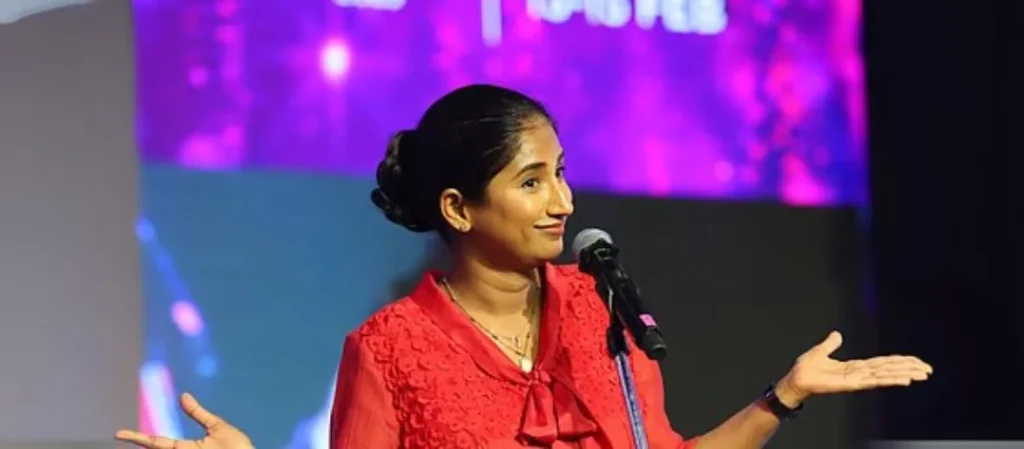
Bengaluru’s stage already has performers who work this way. Shraddha Jain, known
as Aiyyo Shraddha, is a Bengaluru-based comedian and former software engineer
who performs clean observational comedy in English, Hindi, Marathi, Kannada and
Tulu, with material on appraisals, IT life and multilingual quirks. Hosting and
moderating are among the formats she lists. Dr Jagdish Chaturvedi, a Bengaluru-based ENT surgeon turned comedian, performs in English, Hindi and Kannada, and
builds his clean sets around startup life, relationships and doctor-patient
conversations. Bengaluru-based comedians come with different voices, same principle: humour rooted in shared workplace life travels across languages, and a touch of the local one tells the room the
performer belongs to the city.

Music does the same job without needing a shared language at all. A live set can be
the one part of an evening where nobody waits for a translation, which is why
Bengaluru’s live bands and singers, from rock and fusion to folk, are worth
considering alongside the host.
How do you include Hindi speakers and visitors without making
language the story?
Treat it as a planning problem, not a debate. Bengaluru workplaces include colleagues who
moved from other states, leaders who fly in from head offices, and a city where language
can be a sensitive subject. A company event is not the place to take a side, and a good
host does not try. The goal is simply that nobody leaves feeling like the subject of the joke
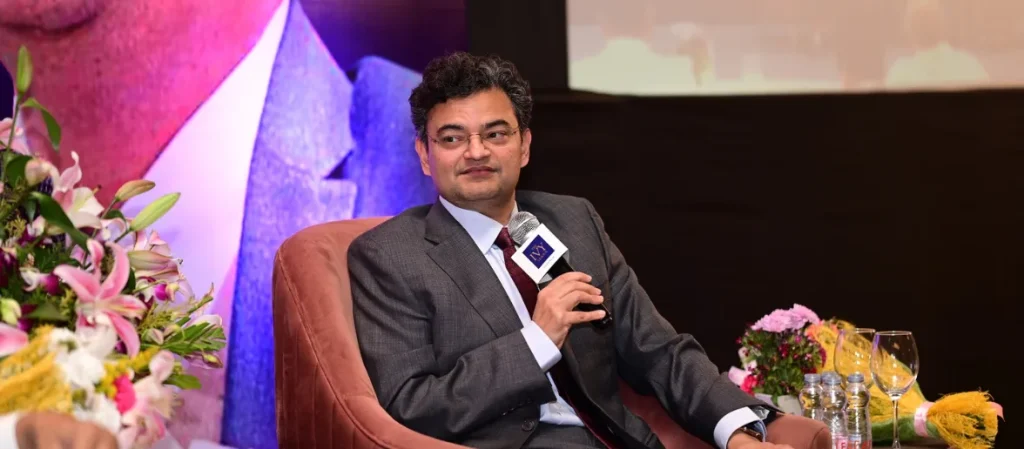
or the odd one out. Speakers like Anand Ranganathan are experts in setting the mood of a multilingual crowd.
In practice, a few habits do most of the work, and a good host picks them up quickly. They
signpost, saying the key point plainly in the shared language before moving into anything
playful, so no one depends on catching a half-heard phrase. They say anything essential,
such as an award result, a safety note or a policy change, once in the common language
rather than switching mid-sentence, because mid-sentence switching is where laugh lag
turns into lost meaning. And they never make language itself the punchline: the moment
someone is singled out for how they speak, the evening becomes about that person
instead of the company.
For visiting delegations, a one-line bridge, a sentence of context for anything local, keeps
guests in the room without slowing the people who already know.
Does the right mix change with the audience?
Always. A product startup, where colleagues share a few languages and an informal
culture, can carry more Kannada and looser code-switching, because the room will meet
the host halfway. A global capability centre with leadership dialling in from abroad wants a
crisper, English-led programme with Kannada warmth at the edges, since part of the
audience is watching on screens across time zones. A campus event for graduate trainees
from many states leans on shared humour and visible energy rather than on any one
language. And a programme that includes plant, warehouse or support teams, for whom
English may be a second or third language, should say the important things more simply,
and in more than one language, than the average event would.
None of this stays fixed. The mix changes as the team does, which is why it belongs in a
conversation rather than a template.
Who decides the language, and when?
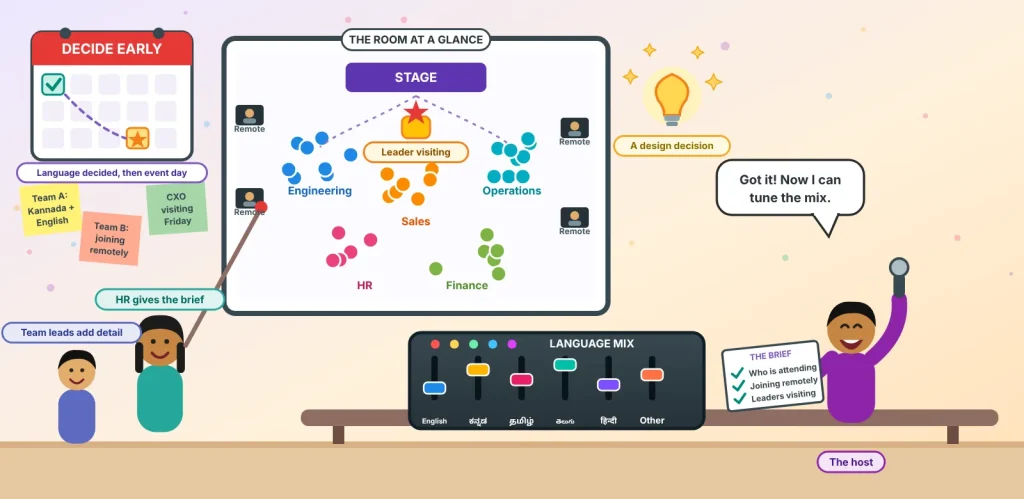
Decide it before the host is chosen, not after. The cleanest approach is for HR to give the
host a rough picture of the room: which functions are attending, where the teams come
from, how many are joining remotely, and whether leadership is visiting. That does not
mean surveying anyone’s mother tongue, which would be intrusive and unnecessary.
Team leads usually know their people well enough to describe the room in a few
sentences. With that picture, HR and the host can agree on a working language, the
moments for local warmth, and how to handle the lines that matter most.
Emcees who host Bengaluru corporate events tend to read that picture quickly, and that
is what separates a considered briefing from improvisation at the microphone.
Language, in the end, is a design decision. Make it early and the host can spend the
evening on the room instead of on the translation.
Planning an event in Bengaluru?
The engage4more Bengaluru team can help you find a host who fits the audience you
actually have. Browse the Bengaluru emcee line-up, see
India if your programme travels to other cities.
anchors and emcees across India if your programme travels to other cities.
FAQs
Q. Do Bengaluru offices prefer English hosting?
Most mixed workplaces use English as the working language, so English-led hosting is the
usual default for programmes with slides, policy or global leadership. Preferences still vary
by audience. Teams that share a regional language often respond warmly to short, natural
touches of it, provided the essential content stays in English.
Q. Is Hindi acceptable at a Bengaluru corporate event?
Hindi will be comfortable for some people in the room and unfamiliar to others. Use it
sparingly, never as the only language for important content, and keep language itself out
of the jokes. The safest approach is a shared working language with brief, optional
touches of others.
Q. How do you host for a mixed Kannada, Telugu and Tamil audience?
Pick one shared working language, usually English, and add short local touches nobody
has to translate, such as a greeting or a thank-you. Avoid jokes that rely on one language’s
wordplay. If one group dominates the room, acknowledge the others at least once so
nobody feels like a guest.
Q. Who should choose the language of a corporate event?
HR and the host should agree it together, before the programme is drafted. HR knows who
is attending and what the occasion needs; the host knows what works on stage. A short
briefing on audience mix, remote attendees and visiting leaders is enough to settle the
working language and local touches.