New Hire Induction
The first 90 days dictate an employee's long-term loyalty. As India's premier employee engagement company, engage4more curates high-impact onboarding and induction activities designed to eliminate isolation and accelerate time-to-productivity. Whether your new batch is breaking the ice with ... Read More
Book Top New Hire Onboarding & Employee Engagement Activities
Loading cards...

FAQs
engage4more's new hire team building activities are designed specifically for onboarding — low-pressure icebreaker formats that help new employees learn names, build early connections, and feel welcomed on day one, rather than generic team games repurposed for induction.
Good icebreakers for new employee orientation are low-stakes and don't require prior company knowledge — quick paired introductions, light trivia about the team, or a short collaborative challenge. engage4more designs these specifically so new hires aren't put on the spot in front of people they've just met.
The induction activities that work best for new employees combine a name-learning component with a light collaborative task, giving new hires a natural reason to talk to colleagues rather than an awkward round of self-introductions.
A new hire icebreaker session typically runs 30 to 60 minutes, enough to build initial familiarity without eating into the rest of the onboarding agenda.
Yes. engage4more runs new hire induction icebreakers virtually for remote onboarding, using formats designed so new employees who haven't met in person yet still walk away having genuinely interacted with the team, not just watched a slide deck.
New hire induction icebreakers work for groups from a handful of new joiners up to large batch-hiring cohorts of 100+, with the format adjusted so everyone gets meaningful interaction regardless of group size.
New hire induction activity pricing depends on group size, session length, and format. Share your headcount and onboarding date with engage4more for an itemised quote within 24 hours.
Yes. Induction icebreakers are commonly built into a full onboarding day agenda alongside policy sessions and role training, positioned early in the day so new hires feel more comfortable for the rest of the sessions that follow.
Book a new hire induction activity 1 to 2 weeks ahead for standard batch sizes, and earlier for large onboarding cohorts scheduled around a fixed joining date.
Share your new hire batch size, joining date, and whether the session is in-person or virtual. engage4more will recommend a suited icebreaker format and send an itemised proposal within 24 hours. For requirements inside 7 days, call +91-8044186906.
New Hire Induction & Onboarding Icebreakers — The First 90 Days Determine Everything That Follows
The research on employee onboarding is striking in its consistency. New hires who experience a structured, socially engaging induction are 58% more likely to still be with the organisation after three years, 69% more likely to report strong cultural alignment, and reach full productivity an average of two months faster than peers who went through a standard process-and-paperwork induction. The first 90 days are not a formality to be managed. They are the highest-leverage window in an employee’s entire tenure — and most organisations squander them on orientation decks and mandatory e-learning modules.
engage4more’s induction and icebreaker portfolio exists to fix that. We design and facilitate high-impact onboarding experiences that do three things simultaneously: build genuine peer-to-peer relationships between new hires who will spend years working alongside each other; integrate new employees into the organisation’s culture, values, and ways of working in a way that feels lived-in rather than lectured; and create a first-day or first-week emotional memory so positive that it sets the tone for everything that follows. The induction experience is the organisation’s first real statement to a new hire about the kind of place this is. We make sure it lands well.
Our induction portfolio spans over 30 formats across 7 categories: structured icebreaker challenges, culture and values discovery programmes, gamified onboarding days, cross-team connection activities, city orientation formats for relocating employees, buddy system facilitation, and large-cohort induction spectaculars. Every format is available as a standalone session or integrated into a full induction programme, and all are facilitated by professionals trained specifically in the psychology of first-impression dynamics and group formation.
The Psychology of Effective Onboarding — Why the First Impression Formats Matter
Onboarding is not just logistics. It is the period during which new employees form their foundational mental models of the organisation: Is this a place where people help each other? Do I belong here? Will I be able to perform? Is the culture I was sold in the interview the culture that actually exists? These questions are answered — consciously or not — within the first week, and the answers set a trajectory that is surprisingly resistant to revision.
The Loneliness Problem in Corporate Onboarding
A 2022 BambooHR study of 1,000 employees found that 70% of new hires reported feeling lonely in their first month, and that loneliness was the single strongest predictor of early attrition. This is not a sensitivity issue. It is a structural one. Most onboarding programmes are designed around information transfer, not relationship formation — and information transfer is something a new hire can do alone at a desk. Relationship formation requires structured social experiences where new hires are given permission and a framework to connect with peers, managers, and cross-functional colleagues in a low-stakes, genuinely enjoyable way.
The Culture Absorption Window
Organisational psychologists describe the first 90 days as the ‘cultural absorption window’ — the period during which new employees are most open to learning how things are done here, most attentive to cultural signals, and most likely to internalise the values and norms they observe and experience. After 90 days, mental models calcify. Behaviours and attitudes set. Values that were not demonstrated in the first quarter become difficult to install later. Onboarding activities that embed culture experientially — through shared challenges, collaborative problem-solving, and facilitated reflection on organisational values — do in one structured day what a year of townhalls and culture decks cannot.
Group Formation Science: The Tuckman Model
Bruce Tuckman’s well-established model of group development describes four stages: Forming, Storming, Norming, and Performing. Unstructured groups move through these stages slowly — often spending months in the Forming and Storming phases before achieving the Norming and Performing stages that produce real collaborative output. Structured induction activities, designed around the specific social dynamics of first meetings, can compress the Forming-to-Norming transition from months to days. New hire cohorts that go through a well-facilitated induction programme are measurably further into the Performing stage at the 90-day mark than cohorts that did not.
Our Induction & Icebreaker Programme Portfolio
1. Structured Icebreaker Challenges
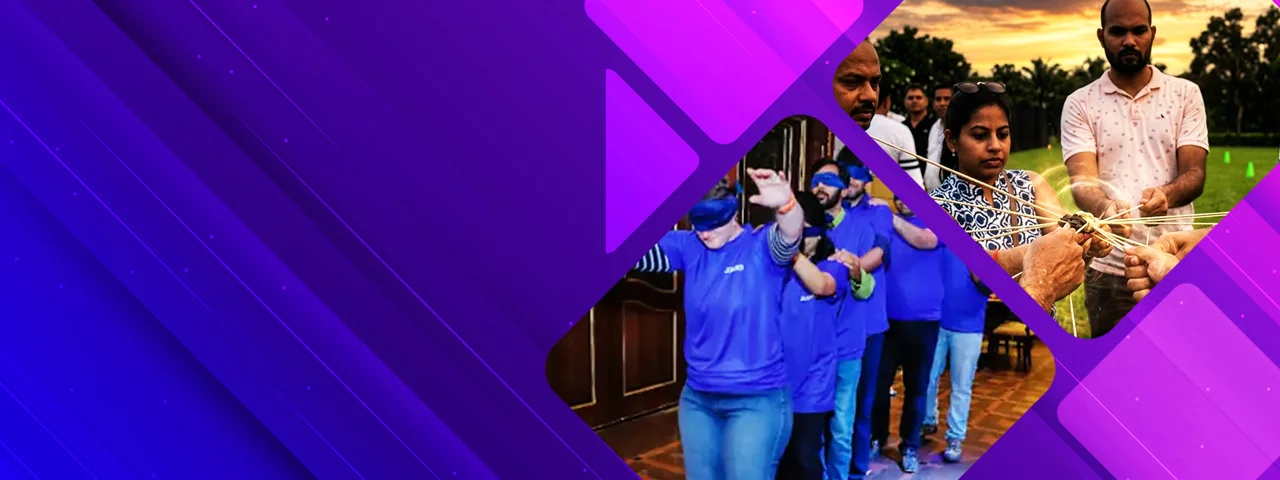
Purpose-designed first-meeting formats that replace the standard round-of-introductions with structured collaborative challenges: Human Bingo (where participants find colleagues who match specific prompts), Two Truths and a Lie with team scoring, Speed Networking with a structured question rotation, and Human Knot and physical connection challenges that require genuine cooperation from people who met minutes ago. Every icebreaker in our portfolio is designed to produce a specific social outcome — peer recognition, shared laughter, a first collaborative success — rather than simply filling time. Available as 60–90 minute standalone formats or as the opening module of a larger induction day.
2. Culture & Values Discovery Programmes
Gamified formats that help new hires discover the organisation’s culture, values, and history through active exploration rather than passive presentation: Company Heritage Trails (where teams decode clues to uncover the organisation’s founding story and milestones), Values Decoder challenges (where each puzzle maps to a stated organisational value), and Culture Code Escape Rooms (where teams must solve a sequence of challenges that embed the organisation’s way of working). These formats sit at the intersection of our induction portfolio and our indoor gamified learning programmes, and are among the highest-rated formats in our onboarding catalogue.
3. Gamified Onboarding Day
A structured full-day or half-day programme that replaces the traditional PowerPoint induction with a sequence of interconnected team challenges covering the organisation’s structure, products, processes, and culture. New employees discover everything they need to know about the organisation by doing, not by listening. They meet colleagues across departments, understand how the business works, and form their first workplace relationships — all within a single, energetic session designed by our instructional designers to produce maximum information retention alongside maximum social integration. Formats are available for cohorts of 10 to 300+ new hires.
4. Cross-Team Connection Activities
Formats specifically designed to integrate new hires with existing employees rather than just with each other: Reverse Mentoring Panels (where new hires share fresh-eyes perspectives with senior leaders), Buddy System Facilitation (structured first meetings between new hires and their assigned buddies with a guided conversation framework), and Cross-Departmental Mix-and-Meet challenges that intentionally pair new hires with team members they are unlikely to encounter in their daily role. These formats address one of the most common onboarding failures: new hire cohorts that bond tightly with each other but remain strangers to the wider organisation. Cross-links to our collaboration team bonding formats are available for combined programmes.
5. City Orientation for Relocating Employees
For new hires who have relocated to a new city for the role, the onboarding anxiety extends beyond the workplace. Our city orientation formats combine practical neighbourhood familiarisation with social bonding: guided city exploration challenges (scavenger hunt formats where teams navigate key city landmarks), local culture and cuisine discovery walks, and neighbourhood-specific orientation sessions that help relocating employees feel at home in their new city as quickly as in their new office. Available in Mumbai, Delhi NCR, Pune, Hyderabad, and Bangalore, with formats designed around each city’s specific character and geography.
6. Large-Cohort Induction Spectaculars
For organisations with large intake batches — campus recruits, annual graduate programmes, or bulk lateral cohorts — we design high-energy induction spectaculars for 100 to 1,000+ new hires: multi-station challenge formats where cohorts rotate through company culture, team challenge, and wellness stations simultaneously; drum circle and Boomwhacker orchestra formats that create a shared peak experience on Day One; and multi-format induction carnivals combining learning, bonding, and celebration. These events set a tone for the cohort that sustains through the entire onboarding period.
7. Virtual & Hybrid Onboarding Activities
For global hires, remote-first organisations, and hybrid cohorts where some new hires join in-person and others join virtually: structured virtual icebreakers, digital escape room formats, online culture quizzes with live hosting, and hybrid formats where remote participants are fully integrated into in-person activities rather than watching from a screen. We offer a comprehensive suite of virtual engagement activities specifically designed for onboarding contexts, facilitated by hosts experienced in managing the attention and energy dynamics of hybrid groups.
Which Induction Format Is Right for Your Cohort and Occasion?
Campus Recruits & Graduate Batch Intakes
Large, cohesive cohorts joining together from campus. Primary need: rapid peer bonding within the cohort, cultural initiation, and energy calibration for the workplace environment. Right format: Gamified Onboarding Day or Large-Cohort Induction Spectacular. Group size: 50–500+. Best timing: Day 1 or Week 1 of the joining programme.
Lateral Hires Joining Individually or in Small Groups
Experienced professionals joining in ones and twos, often at senior levels, with higher role clarity but lower social integration. Primary need: rapid cross-team relationship building and culture absorption at depth. Right format: Cross-Team Connection Activities and Culture & Values Discovery Programme. Group size: 5–30. Best timing: Week 1–2, ideally on a dedicated half-day session rather than squeezed into onboarding admin.
Relocating Employees
New hires who have moved cities for the role and face both workplace and life integration challenges. Primary need: accelerated social anchoring in both the office and the city. Right format: City Orientation for Relocating Employees combined with an icebreaker challenge that pairs them with local colleagues. Best timing: Week 1, as early as possible after joining.
Remote or Hybrid New Hires
New employees joining fully remotely or in a hybrid arrangement where they may not meet colleagues in person for weeks. Primary need: digital relationship formation and cultural inclusion from Day One. Right format: Virtual Onboarding Activities with live facilitation. Best timing: Same day or week as in-person cohort, with parallel virtual track if running hybrid.
Best Occasions to Deploy Induction & Icebreaker Activities
• Day 1 orientation and welcome programme for new hire cohorts
• Week 1 cultural immersion sessions for lateral hires
• Annual campus graduate intake — bulk cohort onboarding programmes
• Mid-year lateral hire integration events
• Post-probation cohort consolidation sessions (end of 90-day window)
• New team formation after restructuring, mergers, or re-organisations
• Buddy programme launch events pairing new hires with existing employees
• City orientation days for employees relocated from other cities
• Leadership onboarding — new managers or directors integrating into their teams
• Return-to-office integration for employees joining a hybrid organisation for the first time
Where We Deliver New Hire Induction & Icebreaker Programmes
Our induction programmes are delivered across India at corporate premises, training venues, and city locations. Our facilitators are experienced in the specific cultural and professional norms of each city, enabling contextually appropriate programming.
New Hire Induction in Mumbai — Large-cohort induction programmes for BFSI, pharma, and media sector campus intakes in BKC, Lower Parel, and Andheri; city orientation walks covering Fort, Bandra, and BKC for relocating employees; hybrid onboarding programmes for distributed teams with Mumbai headquarters and remote regional offices.
New Hire Induction in Delhi NCR — Graduate intake programmes for government, consulting, and IT sector organisations across Gurugram and Noida; heritage trail formats covering Connaught Place, Lutyens’ Delhi, and Cyber Hub for city-orientation sessions; large-cohort induction spectaculars for PSU and manufacturing sector bulk intakes.
New Hire Induction in Pune — Campus intake onboarding for IT and engineering sector cohorts across Hinjewadi, Kharadi, and Magarpatta; city orientation formats covering Koregaon Park, FC Road, and Shivajinagar for relocating employees; culture and values discovery programmes for automotive and manufacturing sector lateral hires.
New Hire Induction in Hyderabad — Large-format gamified onboarding days for pharma and IT sector campus intakes across HITEC City, Gachibowli, and Madhapur; city orientation sessions covering the Old City, Banjara Hills, and Jubilee Hills for relocating employees; hybrid induction programmes for distributed teams with Hyderabad hub offices.
New Hire Induction in Bangalore — Startup and technology sector induction programmes for cohorts joining Whitefield, Electronic City, and Sarjapur Road campuses; culture and values discovery formats designed for Bangalore’s fast-moving startup culture; city orientation walks covering Indiranagar, Koramangala, and MG Road for employees relocating from other cities.
Don’t see your city? We deliver pan-India including Chennai, Kolkata, Ahmedabad, Jaipur, Chandigarh, and beyond. Virtual and hybrid formats are available for any location.
Flawless Delivery: The S.P.A.R.K.S. Execution Methodology
“New hires are naturally anxious. Throwing them into an unstructured activity on Day One can cause introverts to withdraw, extroverts to over-perform, and the cohort to polarise before it has had a chance to form. Our S.P.A.R.K.S. delivery methodology guarantees a highly structured, psychologically safe environment from the first moment. The Startle — our opening facilitation move — breaks down hierarchical intimidation and creates genuine social permission for strangers to connect. The closing Synthesis connects the activity explicitly to the organisation’s values, culture, and ways of working, so participants leave knowing not just the people in the room but the kind of organisation they have joined. Combined with our MORE² diagnostic framework, which helps us understand your specific cohort’s demographic composition, cultural mix, and onboarding objectives before designing the programme, every engage4more induction experience is built for your actual new hires — not for a generic intake batch.”
Frequently Asked Questions (FAQs)
Q1: Why are structured induction activities more effective than a standard orientation programme?
A: A standard orientation programme transfers information: org charts, HR policies, IT setup, compliance modules. Structured induction activities transfer something more valuable: social belonging, cultural understanding, and peer relationships. Research consistently shows that new hire attrition in the first 90 days is driven almost entirely by social and cultural disorientation — not by inadequate information. Employees who do not feel they belong, who do not have a friend at work by the end of Week 1, and who do not understand the cultural norms leave — regardless of how thorough their policy briefing was. Structured induction activities address the actual drivers of early attrition. Orientation programmes typically do not.
Q2: Are these activities suitable for introverted new hires?
A: Absolutely. The MORE² engagement framework that shapes our programme design specifically addresses the introvert-extrovert dynamic in group activities. We use structured collaboration rather than forced public speaking, allowing introverts to contribute at depth without being thrust into the spotlight. Formats like values discovery challenges, problem-solving activities, and culture trail formats are designed to give introverts a clear, meaningful role that plays to their strengths — analytical thinking, careful observation, strategic planning — rather than requiring performative social energy. Post-session feedback from introverted participants consistently rates our induction formats higher than unstructured social events precisely because the structure removes the anxiety of open-ended socialisation.
Q3: Can you facilitate onboarding for remote or hybrid new hires?
A: Yes. We offer a comprehensive suite of virtual engagement activities specifically designed for onboarding contexts — including virtual icebreakers with live hosts, digital escape room formats, online culture and values discovery games, and hybrid formats where remote participants are fully integrated into in-person activities rather than watching passively from a screen. For hybrid cohorts, our facilitators are trained in the specific challenge of maintaining equal energy and participation quality across physical and digital participants simultaneously. We do not treat remote participants as secondary attendees; they receive the same quality of facilitated experience as those in the room.
Q4: How quickly can you mobilise an induction programme for a large campus intake?
A: For standard formats (structured icebreakers, gamified onboarding day, culture discovery activities) for cohorts up to 200 new hires, 2–3 weeks is sufficient. For large-cohort induction spectaculars of 200–1,000+ new hires — requiring multi-station logistics, additional facilitator teams, and custom branded materials — 4–6 weeks is recommended. For organisations with predictable annual intake cycles (campus recruitment joining in July–August or January–February), we recommend a standing engagement to plan and execute each cohort’s induction programme, which reduces lead times and ensures consistent quality across batches. Reach out early and we will hold a preliminary slot while your joining dates are finalised.
Q5: How do you ensure new hires from diverse backgrounds and regions feel included?
A: Inclusion design is built into every format in our induction portfolio. At the facilitation level, our S.P.A.R.K.S. framework explicitly trains facilitators to create structures that give every participant — regardless of language background, regional culture, seniority level, or personality type — a meaningful way to contribute. At the content level, we design icebreaker prompts, team challenge scenarios, and culture discovery activities that draw on shared human experiences rather than culturally specific references. For cohorts with significant linguistic diversity, we offer multilingual facilitation in Hindi, English, Tamil, Telugu, Kannada, Bengali, and Marathi. For cohorts with international members, we design explicit cultural introduction activities that celebrate rather than flatten the diversity in the room.
Q6: What is the difference between an icebreaker and a full onboarding programme?
A: An icebreaker is a single, focused activity (typically 45–90 minutes) designed to dissolve the social awkwardness of first meetings and establish basic peer familiarity. It is valuable as a Day 1 opener but insufficient on its own to achieve cultural integration or deep relationship formation. A full onboarding programme is a structured sequence of experiences across 1–3 days that covers peer relationship formation, cultural immersion, organisational orientation, and role clarity — each addressed through a different experiential format. Most organisations under-invest in the middle ground: they run an icebreaker on Day 1 and then return to information transfer for the rest of the induction week, missing the cultural absorption window entirely. engage4more helps you design and deliver the full programme, not just the opening activity.
Q7: Can induction activities be customised to reflect our specific company values or culture?
A: Yes — and this customisation is strongly recommended. Generic icebreakers produce generic social outcomes. Customised induction activities that embed your specific organisational values, history, and cultural norms produce new hires who are genuinely culturally oriented by the end of their first week. Our design team works with your HR or Culture team to extract the specific values, behaviours, and cultural stories you want new hires to absorb, and builds them into the challenge design, debrief frameworks, and facilitation language of the programme. The result is an induction experience that feels distinctly ‘us’ rather than an off-the-shelf activity that could have been run by any organisation.
Q8: Should new hire induction activities include existing employees or be new-hire-only?
A: Both formats are valid and serve different objectives. New-hire-only formats — particularly for large campus intake cohorts — allow the cohort to bond quickly with each other, which is valuable for the peer support network they will rely on during the adjustment period. Cross-integration formats that mix new hires with existing employees produce faster organisational integration and reduce the ‘new hire bubble’ that can form when large cohorts bond too exclusively with each other. The right choice depends on your cohort size, the maturity of your existing team, and your onboarding philosophy. For most organisations, we recommend a new-hire-focused Day 1 icebreaker followed by a cross-integration activity in Week 2 that deliberately mixes new hires with existing team members. We design both components.
Q9: How do you measure the impact of an induction programme?
A: We track three categories of outcome. Immediate: post-programme survey measuring social comfort (Do you know three colleagues you can ask for help?), cultural understanding (Can you name the organisation’s top three values and give an example of each?), and experience quality. 30-day: a pulse check measuring social integration progress, perceived cultural fit, and early engagement signals. 90-day: alignment with your organisation’s standard new hire survey, with our programme participants benchmarked against non-participants or prior cohorts. For organisations running recurring intake programmes, we track cohort-over-cohort trends in 90-day retention, time-to-productivity, and new hire engagement scores — giving your HR team reportable data on the ROI of the induction investment.
Q10: Can the induction programme be combined with a broader Annual Day or town hall event?
A: Yes — and this is a natural combination. Many organisations choose to formally introduce their new hire cohort to the wider organisation during a Foundation Day, Annual Day, or All-Hands event, with an induction activity serving as the structured integration moment within the larger event. We design these embedded formats carefully to ensure new hires are positioned as participants — not spectators — in the larger event, using collaboration team building activities or music and rhythm formats that allow new hires to contribute alongside existing employees from their very first company-wide event.
Q11: What makes engage4more’s induction programmes different from a standard HR team-run activity?
A: Three things. First, facilitation quality: our facilitators are trained specifically in the psychology of first-impression dynamics and group formation, not in generic event management. They know how to read the energy of a room of strangers, when to push and when to give space, and how to ensure every participant — introvert, extrovert, senior, junior, local, relocating — has a positive experience. Second, design precision: our programmes are built around specific social and cultural outcomes, not ‘fun activity’ as a proxy for integration. Third, the MORE² Diagnostic informs the design: we understand your cohort’s specific composition and your organisation’s specific culture before recommending a format, rather than offering the same programme to every client.
Q12: How do induction activities contribute to long-term employee retention?
A: The connection between onboarding quality and long-term retention is one of the most robustly evidenced relationships in HR research. The mechanism is straightforward: employees who form genuine workplace friendships in their first 90 days are significantly less likely to leave in the first two years, because the social cost of leaving — the loss of those relationships — becomes a meaningful retention factor. Employees who feel culturally aligned and values-connected in their first week are more likely to self-select into the organisation’s informal networks, contribute discretionary effort, and develop the organisational identity that makes retention durable. engage4more’s induction programmes are explicitly designed to accelerate both of these dynamics — social belonging and cultural connection — within the first week rather than leaving them to chance.