

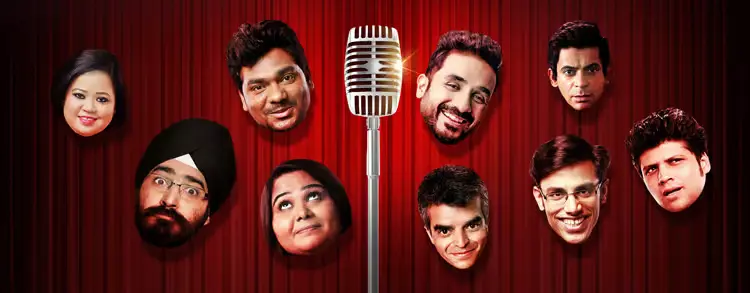
Stand-up comedy has become one of the most sought-after entertainment formats at Indian corporate events, from employee town halls and annual days to sales kick-offs and channel partner meets. Done right, a comedy show does something no team-building activity, no motivational speaker, and no awards ceremony can replicate: it breaks every hierarchy in the room simultaneously and makes the entire organisation laugh together.
Done wrong, it creates an incident that HR is still explaining six months later.
The difference is almost never the comedian’s talent. It is almost always the process the event organiser followed, or failed to follow, before the artist ever walked on stage. After 15 years and over 2,000 comedy bookings for India’s top corporate organisations, we at engage4more have seen both ends of this spectrum enough times to build a framework around it.
This guide gives you the complete planner’s checklist, anchored in our proprietary P.U.N.C.H.Y. framework, the operating manual for corporate comedy done right.
Why Corporate Comedy Needs a Checklist At All
Comedy is the highest-risk, highest-reward entertainment format available to a corporate event organiser. Unlike a musician, whose set is largely fixed, a comedian is in active, live conversation with the room. The show is unscripted at the edges, deeply context-dependent, and held together by a single thread of momentum. A wrong word, a misjudged audience, a poorly briefed performer, or a broken mic at the wrong moment — any one of these can unravel sixty minutes of goodwill.
At the same time, when it works — when a comedian has been chosen right, briefed right, and set up right — the results are unlike anything else in the corporate experience toolkit. Teams that laugh together build psychological safety faster than any structured activity can manufacture.
The six essentials below map precisely to the six pillars of our P.U.N.C.H.Y. framework. Each pillar protects a different dimension of the show — together, they protect the upside and eliminate the downside.
The 6 Essentials: Your Corporate Comedy Planner’s Checklist
1. Style Selection — P is for Personality Fit
The single biggest planning mistake is selecting a comedian based on fame rather than fit. A nationally recognised name guarantees nothing if their style of comedy does not speak to the specific room you are putting them in front of.
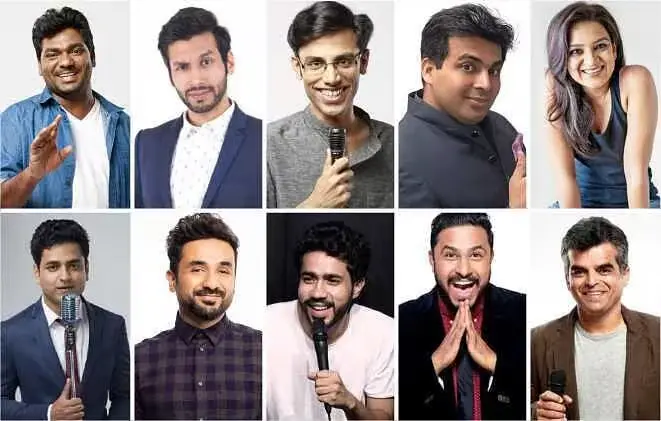
India’s stand-up comedy landscape is remarkably diverse across style, language, and audience sensibility:
Clean, family-friendly comedy — Amit Tandon has built a loyal corporate following on observational humour about family and everyday life. He is exceptional for employee family days, large mixed-audience town halls, and multigenerational events.
Urban millennial sensibility — Abhishek Upmanyu, a software-engineer-turned-comedian, speaks directly to the aspirations and anxieties of young professionals. Biswa Kalyan Rath, IIT Kharagpur graduate, plays beautifully to analytically minded, technically educated audiences — often the hardest rooms to crack.
Warm, multilingual storytelling — Kenny Sebastian brings a musical dimension and cross-regional fluency that almost nobody on the Indian circuit replicates. He is exceptional for large-format events where the audience spans multiple backgrounds and languages.
English-language corporate specialists — Sorabh Pant, Atul Khatri, Angad Ranyal, Sahil Shah, and Sapan Verma — all East India Comedy alumni — collectively represent the most experienced English-language corporate performers on the circuit. These are the natural choices for leadership offsites and CXO-level events.
Female voices — Aditi Mittal , Neeti Palta , Aishwarya Mohanraj, Rupali Tyagi (MBA, decade of corporate IT and HR experience before comedy), and Ramya Ramapriya (sharp South Indian perspective that crosses language barriers) bring genuine representation to events celebrating diversity. Browse the full female stand-up comedians roster on engage4more.
Regional and language-specific — For audiences with a specific language or cultural identity, a local comedian is a performance multiplier. Sai Kiran carries an authentic Hyderabadi voice no out-of-city performer can replicate. Dr. Jagdish Chaturvedi — ENT surgeon and stand-up comedian — resonates deeply with healthcare, pharma, and R&D organisations. For Hindi-language audiences who want a poetic tradition, the Hasya Kavi roster offers an entirely different format with deep cultural resonance.
Emerging talent — Rahul Subramanian, Nishant Suri, Shraddha Jain, and Anshu Mor represent the next generation of corporate comedy — Comicstaan winners, YouTube stars, and multilingual performers who arrive with pre-built audience credibility.
|
P.U.N.C.H.Y. — Personality Fit: Remove the comedian’s name from their profile and describe only their style and typical audience. Does that description still match the room you are planning for? If you are hesitating, the fit is probably wrong. |
2. Budget — C is for Cost Clarity
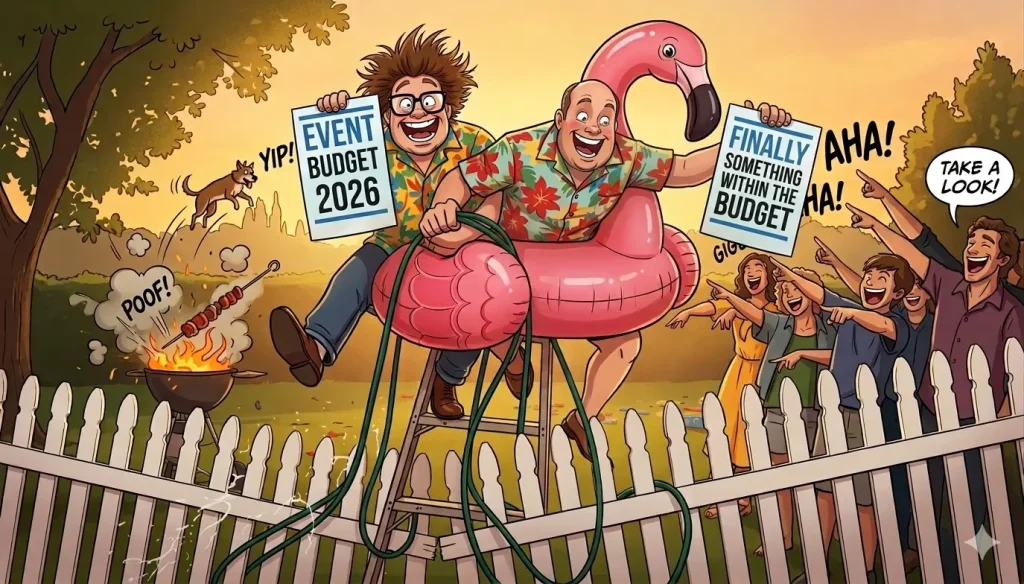
Define your investment bracket before you begin shortlisting names — not after you have watched three videos and mentally committed to an artist.
Comedy fees in India operate across a wider range than most organisers expect:
- Emerging artists — Nishant Suri, Rohan Gujral, Aashish Solanki, Sai Kiran — typically start from around ₹50,000 and represent exceptional value when the style match is right.
- Mid-tier corporate specialists — Angad Ranyal, Sapan Verma, Sahil Shah, Rahul Subramanian, Abijit Ganguly — range from approximately ₹1.5 lakhs to ₹5 lakhs.
- National names with OTT specials — Sorabh Pant, Atul Khatri, Biswa Kalyan Rath, Abhishek Upmanyu, Kenny Sebastian — command fees that reflect their standing.
There is also a hidden cost variable most organisers underestimate: geography. A local comedian not only saves on travel and accommodation — they often bring a natural cultural fluency with regional audiences that no out-of-station artist can replicate.
At engage4more, our process always begins with a budget bracket conversation before we present a single name. This keeps the decision strategic rather than sentimental.
|
P.U.N.C.H.Y. — Cost Clarity: Has the budget bracket been approved internally before you have watched a single video or shortlisted a single name? |
3. Content Guidelines — N is for No-Go Zones
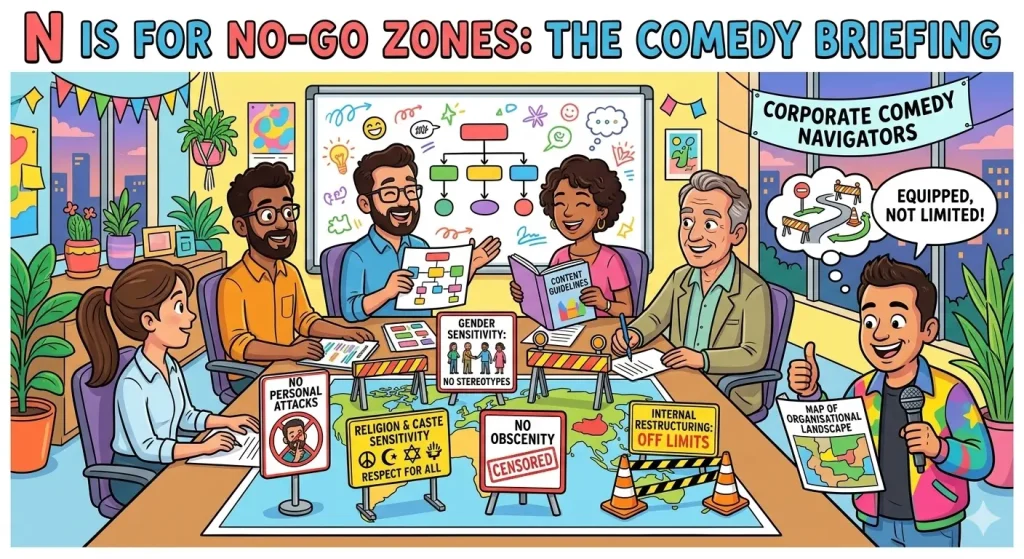
Every corporate organisation carries invisible fences. Gender dynamics in the workplace. A recent restructuring announcement. The regional diversity of the workforce. A senior leader known internally for a particular characteristic. The organiser needs to decide, consciously and in advance, which of these can be touched and which cannot.
Share your content guidelines with the comedian before the briefing call, not during it. At minimum, cover:
- Inclusivity and gender: no material that demeans, stereotypes, or makes any group feel unwelcome
- No personal remarks about employees, however senior or junior
- No use of obscene or explicitly sexual language in a workplace context
- Sensitivity around caste, religion, and regional identity — particularly relevant in India’s diverse corporate workforces
- Any specific internal topics off-limits given recent company events
Here is the counterintuitive truth: a well-briefed comedian does not feel limited by these boundaries. They feel equipped. The No-Go brief is not a cage; it is a map of the organisational landscape shared with a skilled navigator.
The briefing call should be attended by a senior member of the organising committee — ideally someone with genuine cultural authority in the organisation, not just the junior event coordinator.
|
P.U.N.C.H.Y. — No-Go Zones: Have you shared not just the formal content guidelines, but the unwritten cultural rules of your organisation with the comedian? |
4. Fresh Material — U is for Unheard Content
India now has one of the most active stand-up comedy ecosystems in the world. Your employees have watched hundreds of hours of their favourite comedians on YouTube and Netflix. They know the setups. Some of them can finish the punchlines before the comedian delivers them.
Nothing deflates a room faster than a comedian performing material the audience has already seen.
A professional corporate comedian maintains two separate creative vaults: their public-facing content (YouTube, OTT specials, live tour sets) and their corporate set — fresh, never-uploaded, audience-specific material developed for the live event circuit. Confirm, in the briefing call and in the contract, that the material being performed has not appeared on any public platform.
This is not a formality — it is the entire basis of the show’s value. Abhishek Upmanyu, Biswa Kalyan Rath, Rahul Subramanian, and Kenny Sebastian each have digital followings in the millions. A meaningful proportion of your audience has already consumed their most beloved public material. The corporate set must be different.
This is not a formality — it is the entire basis of the show’s value. Abhishek Upmanyu, Biswa Kalyan Rath, Rahul Subramanian, and Kenny Sebastian each have digital followings in the millions. A meaningful proportion of your audience has already consumed their most beloved public material. The corporate set must be different.
|
P.U.N.C.H.Y. — Unheard Material: Can you confirm in writing that the set being performed has not appeared on any public platform? |
5. Session Structure — H is for Hook & Flow
A stand-up comedy session lasts 30 to 45 minutes. It should run unbroken — one continuous set from the moment the comedian walks on stage to the final punchline.
The first five to eight minutes of any set are not the funniest. They are the warmest. The comedian is reading the room, establishing their presence, calibrating the audience’s energy, and earning their trust. This phase — the hook — is the foundation everything else rests on.
If you break the session mid-way — to give a prize, introduce a sponsor, deliver a business update — you do not merely pause the show. You dismantle the momentum the comedian has spent twenty minutes building. When they return to the stage, they are starting the hook again, with an audience that is now distracted and partially disengaged.
One unbroken session of 40 to 45 minutes will always outperform two broken sessions of 20 minutes each, even if the total time is identical.
If business content must be delivered on the same evening, structure the programme so the comedian closes the event. The comedian is the finale, not the interval act.
|
P.U.N.C.H.Y. — Hook & Flow: Is the comedian’s session scheduled as one unbroken block, with all other agenda items placed before it? |
6. Technical Logistics — Y is for “Yes, And” Rehearsal
The “Yes, And” principle comes from improvisational comedy — whatever your scene partner offers, you accept it and build on it. You never block, deny, or leave a variable unresolved. The “Yes, And” Rehearsal is the event organiser’s equivalent: a dry run in which every technical variable gets confirmed, tested, and resolved before show day.
For physical live shows:
- Request the comedian’s full technical rider — microphone type, monitor preferences, lighting requirements — well before show day, not during soundcheck.
- Arrange for the artist to arrive at least one hour before the event begins.
- Soundcheck is not optional. A comedian performing into a microphone they have never tested is a comedian performing into an unknown variable.
- Do a full dry run at least 24 hours before the show.
For hybrid or streamed shows:
- Stable, high-speed wired LAN is non-negotiable. WiFi introduces latency and drop risk that no comedian can perform through.
- Test the microphone, webcam, and platform with the expected audience size — in the same conditions as the actual show.
- The dry run should happen on the same platform, at the same time of day, with the same connectivity setup as the performance.
|
P.U.N.C.H.Y. — “Yes, And” Rehearsal: Has a full dry run been completed — not just scheduled — at least 24 hours before the show? |
How P.U.N.C.H.Y. Connects the Six Essentials
The six essentials above are not independent checklist items. They are interconnected pillars. For the full framework, read The P.U.N.C.H.Y. Framework on engage4more.
|
Pillar |
What It Protects |
|
P — Personality Fit |
The audience’s trust from the first minute |
|
U — Unheard Material |
The show’s freshness and perceived value |
|
N — No-Go Zones |
The organisation’s culture and psychological safety |
|
C — Cost Clarity |
The decision-making process before sentiment takes over |
|
H — Hook & Flow |
The comedian’s momentum and the show’s architecture |
|
Y — “Yes, And” Rehearsal |
Every technical variable resolved before show day |
Miss one pillar and the show is vulnerable. Apply all six, and the show almost cannot fail.
This framework was developed over 15 years of executing comedy bookings for India’s largest organisations. It is not theory. It is a record of what goes wrong when each pillar is skipped, and what goes spectacularly right when all of them are in place.
Nishant Parashar, Founder of engage4more, has over two decades of high-stakes event management experience — from the operational scale of the Mumbai Marathon to talent curation for Times of India brand events. Since 2010, engage4more has partnered with over 5,000 corporate brands across every comedy format: town halls, annual days, sales kick-offs, family events, virtual shows, and large-scale live productions.
engage4more simplifies the whole process of booking by listing stand up comedians under various categories like clean comedy, emerging stars, youtube artists, celebrity stand up artist, location wise selections etc. More importantly , our team understands your budget and give you the best negotiated industry rates with no convenience fee charged. engage4more team also do entire hand holding in terms of artist briefing on content guidelines, logistics support etc so that you can also enjoy the performance along with other event attendees.
Ready to Shortlist?
If these six essentials are in place, the show is set up to succeed. The next step is finding the right comedian for your specific audience. Explore India’s top stand-up comedians on engage4more.
Browse by what matters to your event:
By style: clean comedy · motivational speaking · Hasya Kavi
By language: Hindi · English · regional comedians
By profile: celebrity comedians · emerging stars · YouTube stars · female stand-up · budget-friendly · corporate background
By city: Bengaluru · Mumbai · Delhi & NCR · Chennai
Frequently Asked Questions: Corporate Comedy Booking
How do I choose the best stand-up comedian for my corporate event?
Stop searching by fame and start searching by [personality fit]. To find the right match, explore curated rosters categorized by [style, language, and audience profile] to ensure the comedian’s observational humor aligns with your specific corporate culture.
What is the standard budget for hiring a professional corporate comedian in India?
Budgeting should happen before shortlisting. Comedy fees range from ₹50,000 for [emerging artists] to several lakhs for [national names with OTT specials]. Using a professional platform ensures you receive [best-negotiated industry rates] without hidden convenience fees.
How do I ensure a comedian doesn’t perform recycled YouTube material?
This is the most critical quality check. You must contractually confirm that the comedian is performing a [fresh, corporate-exclusive set] that has not been uploaded to public platforms like YouTube or Netflix. Professional agencies simplify this by vetting [YouTube stars and professional performers] for live-event-specific content.
Can a comedian perform at a virtual or hybrid office event?
Yes, but technical logistics are paramount. Success requires high-speed wired LAN, not WiFi, and a [mandatory technical dry run] on the exact platform you intend to use. Agencies often provide [logistics support] to ensure these technical variables are resolved well before show day.
How do I brief a comedian on company culture without stifling their performance?
Think of content guidelines as a map, not a cage. By sharing [clear “No-Go Zones”]—covering topics like inclusivity, hierarchy, and recent company events—you equip the comedian to be a skilled navigator. Agencies can provide [hand-holding and artist briefing support] to manage this process smoothly.
What is the best way to structure an event agenda with a comedian?
The comedian should always be the finale, never the interval act. To maintain momentum, schedule a [single unbroken session of 30 to 45 minutes] to allow the comedian to build trust and deliver a high-impact performance.