


Father of GNH Centre (Gross National Happiness) shares his secrets of living a life full of joy
Most countries measure their success by what they produce. Bhutan measures it by how happy its people are.
Dr. Saamdu Chetri is available to speak at your corporate event through engage4more. If his philosophy resonates with your organisation’s current challenge, browse his profile and check availability on our Dr. Saamdu Chetri speaker page. Every speaker recommendation goes through engage4more’s STRIVE framework before reaching you.
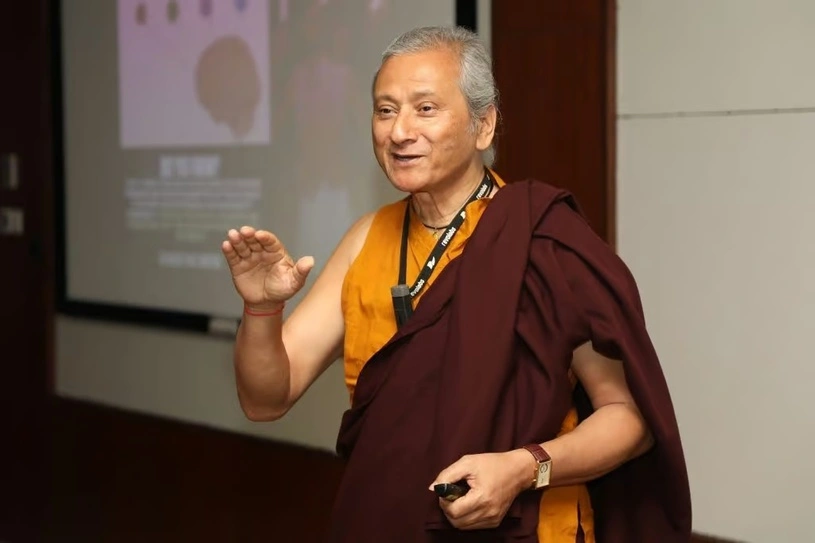
In 1972, Bhutan’s fourth King, Jigme Singye Wangchuck, declared that Gross National Happiness was more important than Gross National Product. It was not a slogan. Over the following decades, Bhutan built an entire governance framework around it — measuring national progress across nine domains including psychological wellbeing, health, time use, cultural resilience, community vitality, and good governance. GDP is one data point among many. How people actually experience their lives is the primary metric.
Dr. Saamdu Chetri was one of the people who built that framework. As a founding member of Bhutan’s Gross National Happiness Centre, and named among the 100 most prominent people in Bhutan’s history, he has spent decades translating GNH philosophy into practice — in schools, in governance, and increasingly, in corporate boardrooms across the world. The BBC called him the Happiness Guru. He has spoken on six continents.
What follows is what 30 years of happiness research — applied at a national governance scale — actually teaches about sustainable performance at work.
Why the pursuit of happiness is the wrong goal

The first thing Dr. Chetri dismantles is the assumption that happiness is a destination — something you arrive at after achieving the right combination of success, wealth, and recognition. The GNH framework does not treat happiness as an end state. It treats it as the quality of the journey itself.
“Happiness is not an end product or a pursuit to follow or an aim to reach at. It is in every action we take.” This is not a motivational platitude. It is a measurable governance principle. Bhutan has built policy instruments around it — assessing not just what citizens have, but how they experience their daily lives.
For a corporate audience, this reframing has a specific and uncomfortable implication. Most organisations are structured around deferred satisfaction — the next promotion, the next funding round, the next quarter’s results. The GNH model suggests that organisations built on perpetual deferral are systematically producing the conditions for unhappiness, regardless of how impressive the outcomes look on paper.
The research supports this. The most productive, innovative, and loyal employees are not the ones who are the most financially rewarded — they are the ones whose daily work experience aligns with something they find genuinely meaningful. Dr. Chetri’s work provides a framework for thinking about how to build that alignment intentionally, rather than leaving it to chance.
The seven principles Dr. Saamdu Chetri teaches corporate audiences
Over his career as a speaker, Dr. Chetri has distilled the GNH philosophy into a set of principles that are applicable to individual leadership, team culture, and organisational design. These are not happiness hacks. They are structural observations about what sustainable human performance actually requires.
1. Today is the only day that exists for action
Dr. Chetri’s first principle addresses where most human energy is actually lost: in the past, which cannot be changed, or in the future, which cannot yet be acted upon. The GNH framework measures time use as a specific domain of wellbeing — not just how much leisure people have, but whether they are genuinely present in the time they are using. ‘What we do today because of the experience of yesterday will prepare us surely for tomorrow’ — the sequencing matters. Yesterday informs today. Today prepares tomorrow. The work is always here.
What this means in a corporate room: For leaders, this principle challenges the organisational habit of constant forward projection — the five-year roadmap that consumes the present, the retrospective that relitigates the past. Dr. Chetri’s framing is not about abandoning planning. It is about ensuring the planning does not displace presence. The best decisions are made by people who are fully in the room, not mentally in the next quarter.

2. A happy person can be remarkably successful. A successful person is not necessarily happy.
This is the inversion that the GNH framework is built on, and it is the one corporate audiences find most difficult to absorb — because it inverts the sequence that most organisations operate on. The standard model: work hard, achieve success, then be happy. The GNH model: cultivate genuine wellbeing, and the conditions for sustainable high performance follow. Dr. Chetri is not anti-success. He is anti the assumption that success produces happiness reliably, because the evidence — at the individual level and at the national level — consistently shows that it does not.
What this means in a corporate room: The organisational implication: employee wellness programs that position happiness as a reward for performance are working backwards. The causation runs the other way. Teams with genuine psychological wellbeing produce better outcomes — not because they are trying harder, but because they are operating from a more functional cognitive and emotional baseline.

3. Wealth accumulation without time for living is the core paradox of modern life
Dr. Chetri draws on a pattern he has observed consistently across cultures: people who spend their most productive years accumulating wealth for a future that arrives differently than expected. Children who settle abroad. Parents who are cared for by strangers. Property that is sold by people who never lived in it. The accumulation was real. But the life it was meant to fund was displaced by the act of accumulating it. This is not a judgment. It is an observation about a structural problem in how many high-performing individuals organise their priorities.
What this means in a corporate room: For HR and leadership audiences, this principle speaks directly to the burnout conversation — specifically to the pattern of high performers who achieve everything their organisation values and find themselves depleted rather than fulfilled. Dr. Chetri offers a framework for understanding why this happens at a systemic level, which is more useful than treating it as an individual failure of resilience.

4. The inward journey is as essential as the outward one
GNH explicitly measures psychological wellbeing as a governance domain — meditation, positive emotions, negative emotions, and spiritual wellbeing are tracked alongside economic indicators. Dr. Chetri’s point is not that everyone should meditate (though he recommends it). It is that no organisation that only measures external outputs has a complete picture of what is actually happening to the people inside it. The inward journey — developing self-awareness, understanding one’s own values, cultivating genuine presence — is not separate from performance. It is foundational to it.
What this means in a corporate room: This principle is particularly relevant for organisations designing leadership development programs. The most effective programs are not just skill-building exercises — they include some form of self-knowledge development, whether through coaching, reflective practice, or the kind of experiential learning that a Dr. Chetri retreat or keynote provides.
5. We are all from the same source — and this changes how we treat each other
This is the philosophical foundation of the GNH framework’s approach to community and social wellbeing. Dr. Chetri draws on both Eastern philosophical tradition and contemporary physics to make a point about interdependence: that the distinction between self and other is less absolute than most of our social structures assume. This is not an abstract spiritual claim. It has specific practical implications for how organisations design relationships between departments, between leadership and staff, between the organisation and its ecosystem.
What this means in a corporate room: For organisational culture conversations, this principle addresses the roots of the silo problem — not as a structural issue to be solved with process, but as a perception issue to be addressed with a different understanding of relationship. Dr. Chetri’s framing gives leaders a philosophical basis for collaboration that is more durable than a team-building exercise.
6. Eliminating the eight obstacles to happiness is more important than pursuing happiness directly
Dr. Chetri identifies eight mental states that consistently prevent happiness: ignorance, suffering, delusion, worry, jealousy, greed, anger, and fear. The GNH framework’s approach is not to pursue positive states directly but to systematically reduce the conditions that generate these eight obstacles. This is a subtractive rather than additive model of wellbeing — and it is notably more evidence-consistent than approaches that simply add positive experiences to an unchanged base of negative mental habits.
What this means in a corporate room: For employee wellbeing programs, this principle suggests that interventions focused purely on adding positive experiences (team lunches, recognition programs, wellness days) will have limited effect if the underlying conditions generating worry, fear, and anger in the workplace are not addressed. Dr. Chetri’s framework helps organisations identify what they need to remove, not just what they need to add.

7. Small consistent practices compound into a different quality of life
Dr. Chetri’s third mantra section in the original blog is a list of daily practices — gratitude, meditation, exercise, prayer, gardening, sharing, teaching, listening, eating consciously. The principle underlying all of them is compounding: small consistent actions performed daily produce a fundamentally different quality of experience over time. No single practice is transformative. The accumulation is.
What this means in a corporate room: For organisations, this principle maps directly onto culture change. No single intervention changes culture permanently. What changes culture is the accumulation of consistent small signals — how meetings are opened, how mistakes are addressed, how success is recognised, what behaviour is modelled by leadership. Dr. Chetri’s framing helps leadership teams understand why culture change feels slow: because it is genuinely cumulative, and there are no shortcuts.
Why Dr. Saamdu Chetri works on a corporate stage
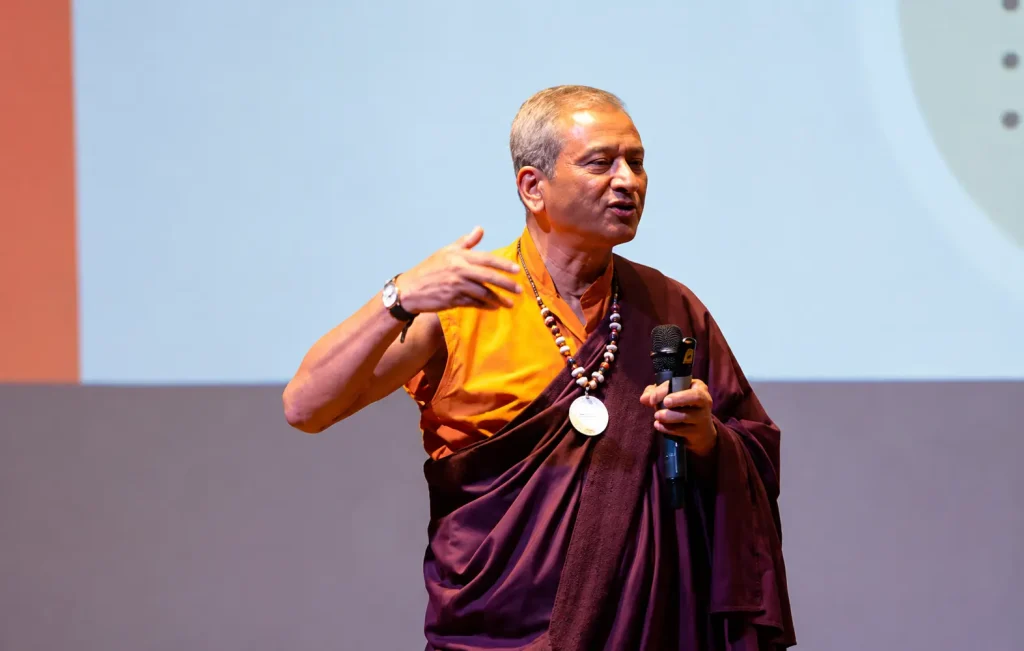
The Gross National Happiness framework is the most formally researched and institutionally implemented happiness philosophy in the world. It is not a wellness blog. It is a national governance system that Bhutan has been running for over 50 years, with measurable outcomes and peer-reviewed research behind it.
When Dr. Saamdu Chetri speaks to a corporate audience, he is not sharing a personal philosophy — he is reporting from a decades-long institutional experiment in what human wellbeing actually requires. That is a different quality of authority than most speakers in the wellness or happiness category can offer.
At engage4more, we apply the STRIVE framework to every speaker recommendation. For Dr. Chetri, the ‘I’ criterion — Impact — is where his sessions consistently distinguish themselves. Audiences leave not just feeling good but thinking differently about the relationship between how they work and how they live. That is a cognitive shift, not just an emotional one, and it is the kind of shift that shows up in behaviour the following week.
His sessions work particularly well for leadership offsites, annual day events with a wellbeing theme, and CXO conclaves where the conversation is about sustainable leadership rather than short-term performance. To explore session formats and availability, visit his speaker profile page.
Considering Dr. Saamdu Chetri for your next leadership event, wellness offsite, or annual day? Browse his session formats and check availability on his speaker profile page. Contact engage4more directly for a transparent fee quote and STRIVE-vetted shortlist within 3 hours. Since 2010, 5,000+ events across India.
Frequently asked questions about Dr. Saamdu Chetri
Who is Dr. Saamdu Chetri?
Dr. Saamdu Chetri is a Bhutanese educator, philosopher, and happiness researcher who served as a founding member of Bhutan’s Gross National Happiness Centre. He has been named among the 100 most prominent people in Bhutan’s history and was referred to as the ‘Happiness Guru’ by the BBC. He speaks globally on GNH philosophy, conscious living, and the application of happiness principles to corporate and organisational life.
What is Gross National Happiness and why does it matter for corporate audiences?
Gross National Happiness is a national development philosophy pioneered by Bhutan that measures progress across nine domains of human wellbeing — including psychological wellbeing, health, time use, cultural resilience, community vitality, and good governance — rather than purely through economic metrics like GDP. For corporate audiences, GNH is relevant because it provides an evidence-based, institutionally-tested framework for thinking about employee wellbeing as a strategic input to performance, rather than a peripheral benefit. Dr. Chetri’s work translates five decades of GNH research into principles that organisations can apply to culture design, leadership development, and employee experience programs.
What kind of corporate events is Dr. Saamdu Chetri best suited for?
Dr. Chetri’s sessions work best for leadership offsites, annual day events with a wellbeing or purpose theme, CXO conclaves exploring sustainable leadership, and corporate wellness programs where the organisation wants to go beyond surface-level interventions. He is less suited to high-energy sales kickoffs or events where the primary objective is entertainment rather than reflection. To discuss whether Dr. Chetri is the right fit for your specific brief, contact engage4more at activities@engage4more.com or visit his speaker profile page.