

The Lifeline Exercise: Why Mid-Size Companies Need This More Than Any Other Team Bonding Format
You know everyone’s name. You’ve nodded in the lift. You’ve been on the same Zoom calls. But do you actually know anyone? The Lifeline Exercise solves this in 90 minutes — and the impact lasts for years.
There’s a specific problem that hits companies at the 50–300 person mark. You’re no longer a startup where everyone knows each other’s story — but you’re not yet an enterprise where anonymity is expected. You’re in the middle: where culture either deepens or calcifies. The Lifeline Exercise is the single most reliable tool for deepening it.
We use it internally at engage4more with our own team. Photographs from our own sessions are on our website. This is not an activity we recommend without having done it ourselves.
Every recommendation here is validated through our MORE² Diagnostic. MORE² identifies whether your team needs Motivation, Onboarding, Reward, or Education, right now. The right activity for a stable, motivated team is completely different from the right one for a newly-formed post-merger team. Learn how the MORE² Diagnostic works.
1. What Is the Lifeline Exercise?
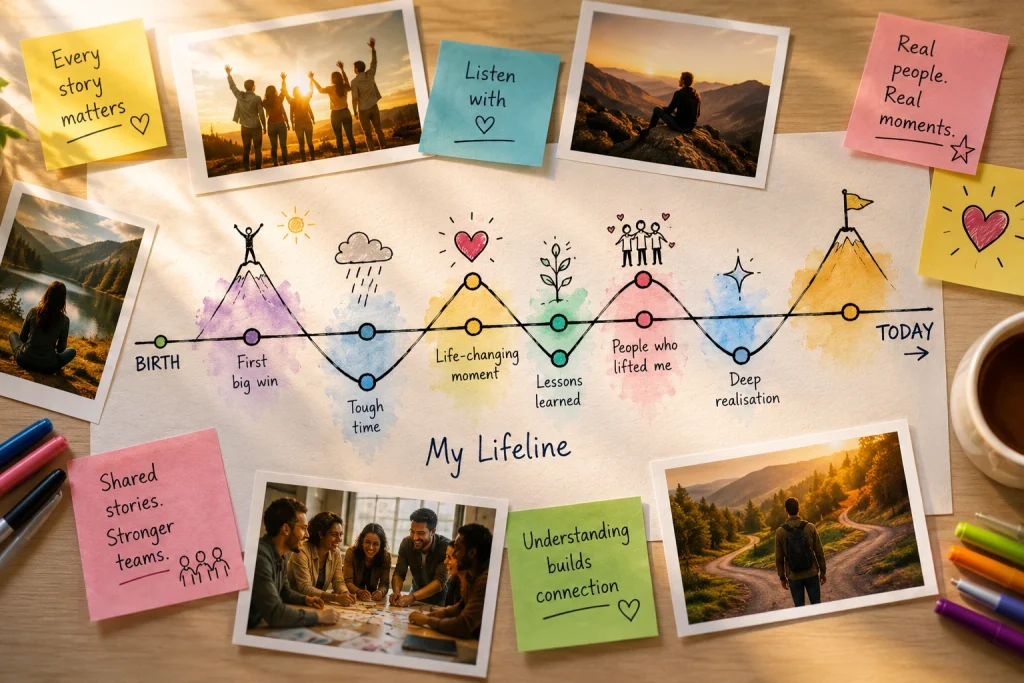
The instruction: “Draw a horizontal line across the centre of your page. Mark your birth on the left and today on the right. Plot the 5–10 moments that have truly shaped who you are peaks above the line, valleys below. You have 15 minutes. There are no wrong answers.”
What happens next is consistently remarkable. People who have sat three desks apart for two years discover shared formative experiences. Quiet colleagues reveal extraordinary resilience. Senior leaders show the valleys that made them — not just the peaks that promoted them. Then the sharing begins: one person at a time, each participant walks the group through their lifeline while a trained facilitator holds the space.
What goes wrong without a trained facilitator: Sharing becomes surface-level — or worse, someone shares something vulnerable into an unprotected space. Without a skilled facilitator to hold the room’s emotional safety, the exercise either stays shallow (wasted potential) or goes deeper than anyone is prepared to handle. The facilitation is not an add-on. It is the product.
2. Why This Is Perfect for 50–300 Person Companies
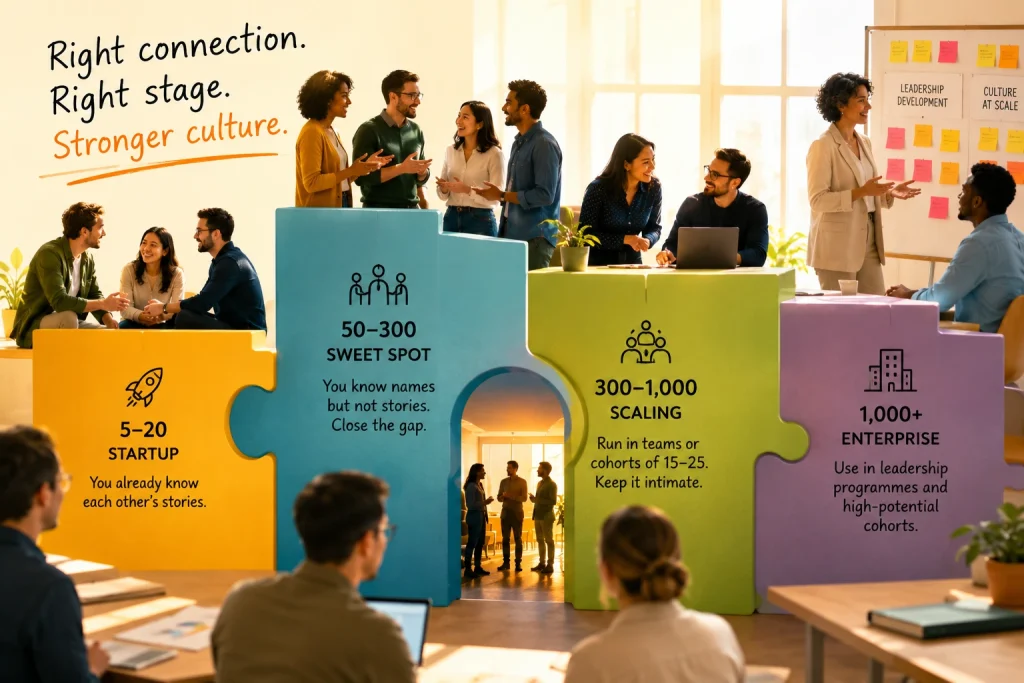
| Company Stage | Why Lifeline Fits |
| 5–20 people (startup) | You probably already know each other’s stories. Use the Purpose Lifeline variation for leadership alignment or new senior hires. |
| 50–300 people ← sweet spot | You know names but not stories. Close enough for intimacy, big enough to have real gaps. The Lifeline closes them in 90 minutes. |
| 300–1,000 people (scaling) | Run in functional teams or cross-department cohorts of 15–25. Never full-company — it loses intimacy. |
| 1,000+ people (enterprise) | Use in leadership development programmes, high-potential cohorts, and department offsites — not all-hands. |
The mid-size paradox: In a 100-person company, you interact with the same 20 people every day and barely know the other 80. Those 80 colleagues shape your product, your culture, and your daily experience — but you treat them as strangers. The Lifeline Exercise closes that gap across the whole organisation in a single session.
3. Why It Works — The Evidence Base
- Brené Brown’s vulnerability research: shared vulnerability is the fastest path to genuine connection. The Lifeline creates structured permission to be vulnerable — removing the social risk of being ‘the only one who shared something personal’.
- Google’s Project Aristotle: psychological safety is the #1 predictor of high-performing teams. Knowing your colleagues’ stories builds this belief.
- Narrative identity theory: people understand themselves and others through stories, not facts. Knowing a colleague overcame adversity changes how you interpret their behaviour under pressure.
- Oxytocin release: shared emotional experiences bond people: The Lifeline does this reliably, at scale, without physical activity or high energy.
4. The Facilitation Guide — What Good Looks Like
| Step | What Happens | Time |
| Frame the session | Facilitator explains the format, shares the instruction, establishes psychological safety rules for the room. | 5 min |
| Facilitator shares first | The facilitator does their own brief Lifeline on a flip chart. This is non-negotiable — it models the tone and signals it’s safe. | 5–7 min |
| Silent drawing | Participants draw in silence. Facilitator circulates gently, no commentary. Soft background music optional. | 15 min |
| Sharing round | Each person shares 3–5 minutes. Facilitator holds time gently, asks one curious question, ensures the group is fully present. | 50–70 min |
| Group debrief | Three questions: ‘What surprised you?’ / ‘What changed about how you see a colleague?’ / ‘What do you take forward?’ | 10 min |
| Appreciation Circle (optional) | Each person names one thing they noticed about the person to their left during the session. | 8–10 min |
5. Variations — Choosing the Right Format
The Full Personal Lifeline:
- Teams with 3+ months together, stable culture, willing leadership
- 75–90 mins
- The classic format. Peaks and valleys across your whole life. Deepest outcomes. Requires a skilled facilitator and genuine psychological safety
The Professional Lifeline:
- New teams, cross-functional groups, early-stage culture
- 60 mins
- Career moments only — not personal life. Less vulnerable, still powerful. Works well for new joiners who don’t yet have full trust
The Purpose Lifeline:
- Leadership teams, values-alignment, post-merger integration
- 75 mins
- Maps the moments that formed each person’s values and ‘why’ — not just events but beliefs. Pairs powerfully with a company values session
The Team Lifeline:
- Established teams, retrospectives, project close-outs
- 45–60 mins
- The team collectively maps its journey — shared peaks and valleys since they started working together. Powerful retrospective format
Want this run professionally for your team? Book Leadership Development activities including the Lifeline Exercise with engage4more
6. Facilitation Safety Notes
- Someone shares a very difficult experience — bereavement, illness, trauma: Hold the space. Thank them. Don’t problem-solve or offer advice. Never rush to the next person.
- Someone shares very little and looks exposed: Normalise brevity. ‘A lifeline can be one moment or ten — both are equally valid.’ Never press for more.
- The session runs longer than planned: Usually a good sign. Check in with the group at 60 minutes and collectively decide whether to extend.
- A senior’s sharing changes the dynamic: When a CEO shares a genuine valley, let it breathe. Don’t rush past it. This is the most powerful moment in the session.
engage4more’s safety protocol: All our Lifeline facilitators complete a 40-hour facilitation training programme and are certified in the S.P.A.R.K.S. methodology before leading this session independently. We brief every client on how to support participants afterwards. This is a structured human experience, not a game.
Powered by S.P.A.R.K.S. — engage4more’s Delivery Methodology
Every activity we facilitate follows S.P.A.R.K.S.: Shared Vision · Principal Values · Altruism · Rules & Policies · Kinship · Smiles & Thrills. This delivery sequence ensures measurable cultural outcomes — not just a good afternoon.
Explore related — book directly with engage4more:
Book Team Offsites activities (Lifeline Exercise, Purpose Workshop)
Book DEI & Inclusion activities (Diversity Storytelling Circle)
Browse our full Corporate Team Building Catalogue
Explore team building activities in your city:
Team Building Activities in Mumbai | Team Building Activities in Delhi NCR | Team Building Activities in Pune | Team Building Activities in Hyderabad | Team Building Activities in Bangalore
Not seeing your city? We deliver pan-India. Reach out to us and our team will design a programme that works for your location, team size, and engagement goals.
FAQs
1. What is the Lifeline Exercise and why is it used in corporate settings?
The Lifeline Exercise is a structured, reflective tool that helps employees map their personal or professional journeys by identifying significant “peaks” and “valleys.” In a corporate setting, it is used to foster deep interpersonal connection, build empathy, and establish psychological safety by allowing team members to share their stories in a safe, facilitated environment.
2. Why is the Lifeline Exercise specifically effective for mid-size companies?
Companies with 50–300 employees often face a “mid-size paradox”: they are too large for everyone to know each other’s history but too small for anonymous, enterprise-style scaling. The Lifeline Exercise fills this intimacy gap by rapidly surfacing the human stories behind the job titles, turning strangers into colleagues who truly understand each other’s values and resilience.
3. Do I need a professional facilitator for a team Lifeline session?
Yes. Without a trained facilitator, the exercise risks becoming either too shallow to be meaningful or, conversely, too emotionally intense for an unprotected workplace environment. A professional facilitator maintains the “emotional container,” ensures psychological safety, manages time effectively, and ensures that the sharing leads to constructive outcomes rather than just passive listening.
4. How does the Lifeline Exercise improve team performance?
Based on principles like Google’s Project Aristotle, psychological safety is the primary predictor of high-performing teams. By sharing formative life experiences, team members move beyond superficial interactions. This builds trust, improves communication, and provides context for how colleagues behave under pressure, directly impacting collaboration and overall performance.
5. What is the difference between a Personal and Professional Lifeline format?
The “Full Personal Lifeline” focuses on significant life events to build deep empathy and long-term trust among stable teams. The “Professional Lifeline” is a more focused, 60-minute variation that centers exclusively on career defining moments. The latter is often better suited for new hires, cross-functional groups, or cultures that are still in the early stages of building deep trust.