

Why Alcohol, Music, and a Great Party Are Sometimes the Best Team Bonding Answer
Not every HR problem requires a workshop. Sometimes your people just need a Saturday they didn’t have to plan themselves and permission to enjoy it.
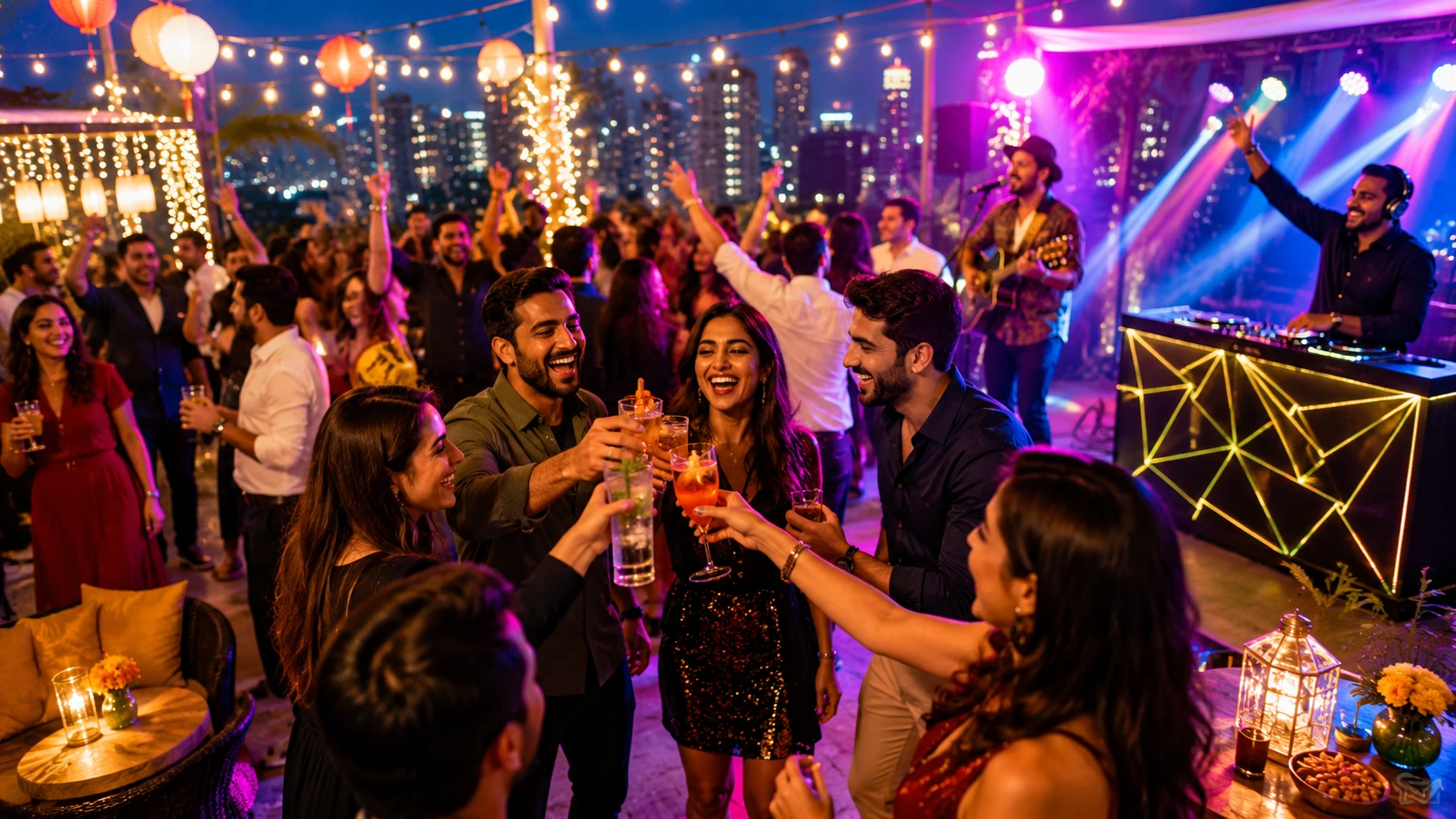
Here’s a statement that will make some L&D professionals uncomfortable: occasionally, the best team bonding investment a company can make is an open bar, a great DJ, and no agenda.
We say this having run 1,000+ employee engagement events across India, structured, facilitated, purposeful events. We believe deeply in the power of the Lifeline Exercise, the War of Departments, the MORE² Diagnostic. And we also believe that sometimes a team just needs to dance together. Not everything requires a framework.
This blog is about knowing when a great party is the right answer and when it isn’t.
Every recommendation here is validated through our MORE² Diagnostic. MORE² identifies whether your team needs Motivation, Onboarding, Reward, or Education, right now. The right activity for a stable, motivated team is completely different from the right one for a newly-formed post-merger team. Learn how the MORE² Diagnostic works.
The Tony Hsieh Principle — Culture Through Collision
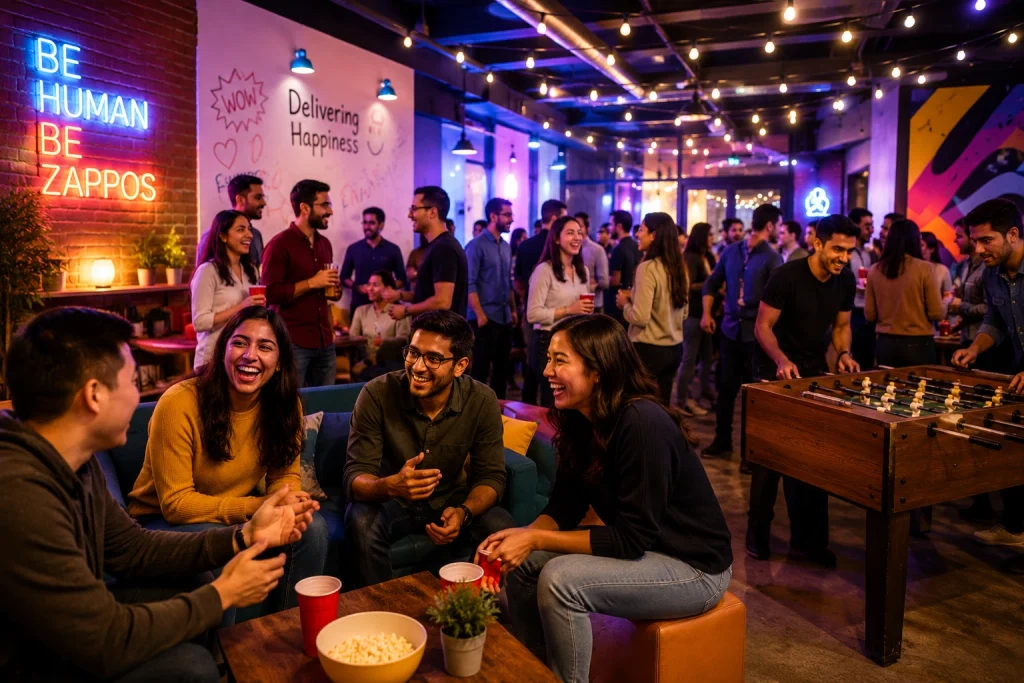
Tony Hsieh, the founder of Zappos and one of the most quoted voices on workplace culture, built an entire company philosophy around the idea that the best cultures are created through spontaneous, unscripted human moments — not managed programmes.
In Delivering Happiness, his memoir of building Zappos, he described how some of the most important cultural moments at the company happened at parties, in hallways, during impromptu conversations that nobody scheduled. His rave party analogy was specific: he described how a rave, where everyone is present, fully in the moment, and experiencing something together, created a depth of social bond that a formal networking event never could. Not because of the music or the atmosphere, but because of the shared surrender to the experience.
The corporate equivalent is not a rave. But the principle holds: when people stop performing their professional identities and simply exist together in an enjoyable moment, connection happens. And that connection has a direct line to collaboration, trust, and retention.
The Zappos data point: Zappos famously tracked how many people employees knew by first name, not as a vanity metric, but as a measure of cultural health. They found that the number of first-name relationships correlated directly with how long people stayed. Parties and informal gatherings were one of the primary mechanisms for building those relationships at scale.
The Quotes Worth Knowing — Why Great Leaders Trust the Party
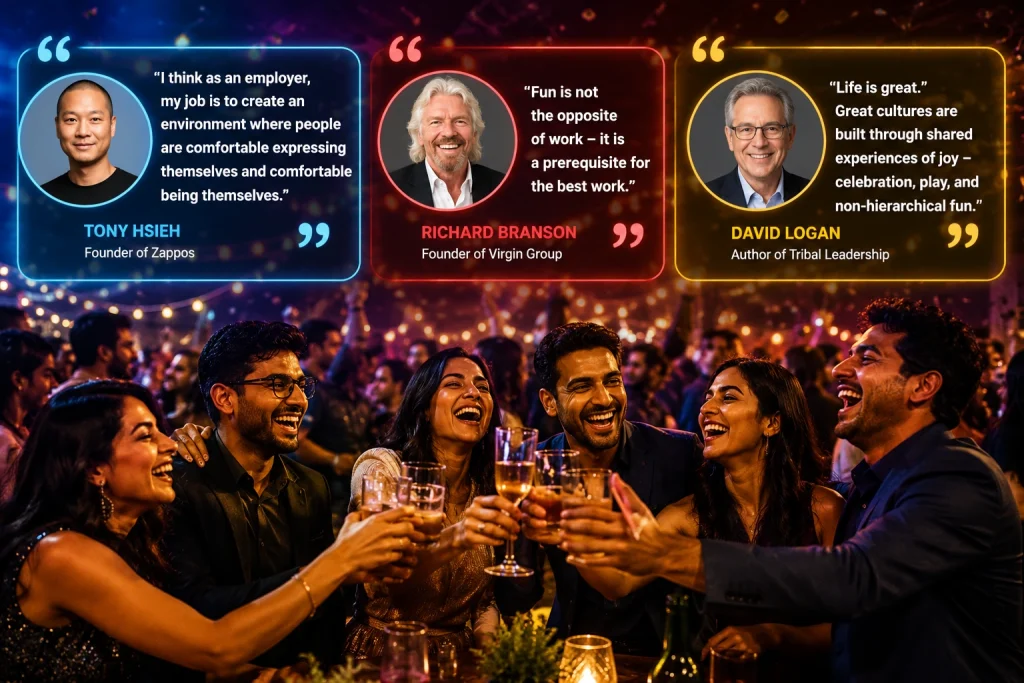
These aren’t feel-good platitudes. They’re observations from people who built billion-dollar cultures:
Tony Hsieh, Founder of Zappos
‘I think as an employer, my job is to create an environment where people are comfortable expressing themselves and comfortable being themselves.’ Hsieh believed that formal team bonding events were often counterproductive, they create performance anxiety rather than genuine connection. His model was to create conditions where people could relax into themselves.
The implication for corporates: sometimes the most expensive thing you can do for engagement is to remove the agenda entirely.
Richard Branson, Founder of Virgin Group
Branson has consistently argued that fun is not the opposite of work, it is a prerequisite for the best work. He is known for hosting elaborate parties for his team at Necker Island. His position: companies that make time for genuine celebration attract and retain better people than those that don’t.
The implication for corporates: a party is not a distraction from the business. It is the business; the business of keeping your best people.
David Logan, author of Tribal Leadership
Logan’s research on workplace cultures identified five tribal stages. Stage 4 culture, the highest functional stage — is characterised by the belief that ‘Life is great.’ His research found that organisations stuck in Stage 3 (‘I’m great and you’re not’) could break through to Stage 4 through shared experiences of joy, celebration, play, and non-hierarchical fun.
The implication for corporates: a great party, done inclusively, can literally shift your company’s cultural stage.
When a Party IS the Right Answer
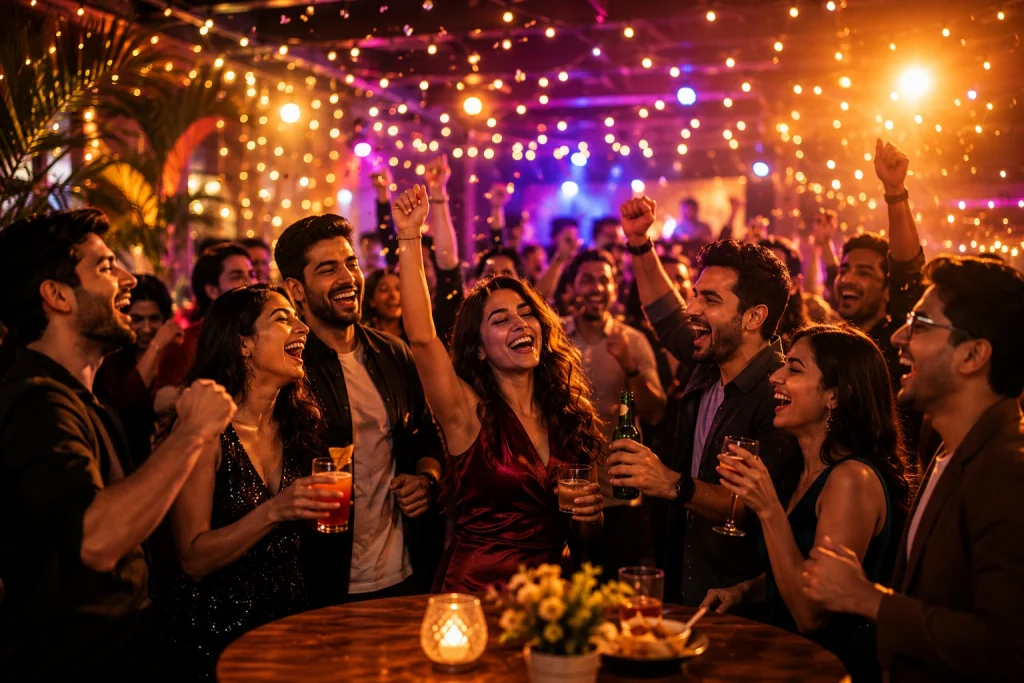
Not every quarter, and not in every situation. But these are the moments where a great party will do more for your team than any structured engagement:
| Situation | Why a Party Works Better Than a Programme |
| Post a brutal quarter, morale in the basement | A workshop won’t fix this. People need to laugh, eat well, drink if they want to, and feel like the company sees their effort. Celebration before reflection. |
| After a major project delivery, team is exhausted but proud | They’ve been heads-down for months. They don’t need a debrief. They need a Saturday where someone else has thought of everything. |
| New team formation, strangers need to become colleagues | Informal settings — good food, good music, a game or two — create first-name relationships faster than any icebreaker exercise. |
| Cultural festivals (Diwali, Holi, Christmas, Eid) | Authenticity over agenda. Let the festival be the event. Add great food, great music, and step back. |
| Annual milestone (company anniversary, target hit) | Celebrate the achievement with the energy it deserves. A party says ‘we made it’ in a way no award ceremony can. |
How to Make a Party Work Harder — Without Making It a Programme
A great party doesn’t need activities. But a few thoughtful design choices can make the connection deeper without adding any agenda:
- One signature moment: a live singer, a comedian set, a DJ who takes requests. One thing people will talk about. Not three things.
- One conversation catalyst: trivia answers on drinks menus, fun facts about colleagues on table cards, a ‘guess whose desk’ wall of photos.
- Zero mandatory activities: everything opt-in. The moment something becomes mandatory, it stops being a party.
- The right music: not background filler. An MC or DJ who reads the room and builds the energy deliberately is the difference between a good night and a great one.
- End at the right time: a party that ends before people want to leave is a legendary party. One that runs too long is an ordeal.
The engage4more approach to party production: We don’t just book the DJ and collect the cheque. We design the party experience; the energy arc, the signature moment, the music curation, the flow from arrival to close. Whether it’s a 40-person team dinner or a 400-person annual day, the approach is the same: remove the agenda, keep the intention
When a Party Is NOT Enough
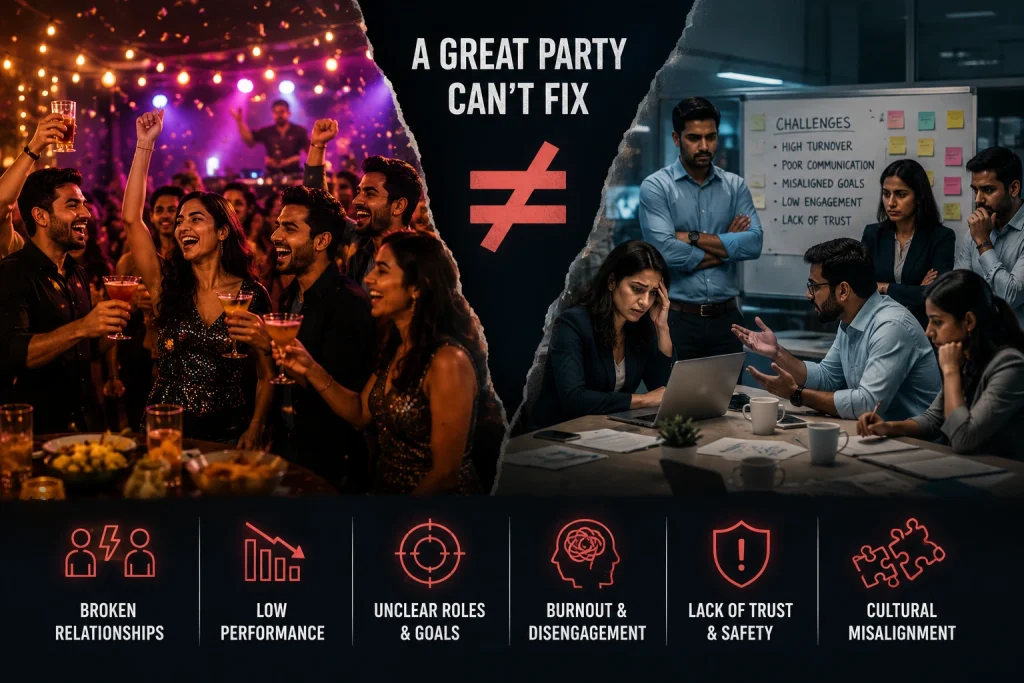
To be completely honest and this is important:
- Post-conflict or low-trust teams: A party in a team that doesn’t trust each other can feel forced and isolating. The people who feel excluded will feel more excluded. Fix the trust first.
- Post-merger or newly formed teams: Strangers need structured icebreakers before they’re comfortable enough to enjoy a party together. Start with Speed Introductions or the Lifeline Exercise.
- Teams with outstanding conflicts or unresolved issues: Alcohol and unresolved tension is a bad combination. Address the issue first.
- When the budget is very tight: A cheap party that signals low investment does more harm than no party. If the budget doesn’t allow a genuinely good experience, redirect it to a lower-cost facilitated activity instead.
The MORE² check before booking a party: If your team’s MORE² Diagnosis shows low Kinship (K), people don’t know or trust each other, start with a structured connection activity before the party. The Lifeline Exercise or Speed Networking in the first 45 minutes, followed by a great dinner and live music, is often the perfect combination. The structure creates the safety; the party creates the joy
What engage4more Can Do for Your Party
We book 5,000+ artists across India comedians, live singers, bands, DJs, emcees. We also produce the entire event experience: venue liaison, production design, lighting, sound, flow design, and post-event content.
More importantly, we’ve been to enough bad corporate parties to know exactly what makes the difference. It’s almost never the budget. It’s the intention behind the design.
Powered by S.P.A.R.K.S. engage4more‘s Delivery Methodology. Every activity we facilitate follows S.P.A.R.K.S.: Shared Vision · Principal Values · Altruism · Rules & Policies · Kinship · Smiles & Thrills. This delivery sequence ensures measurable cultural outcomes, not just a good afternoon.
Explore related — book directly with engage4more:
Book Music & Drum Circle activities — all licences included
Book Musical Tambola for your office
Browse our full Corporate Team Building Catalogue
Explore team building activities in your city:
Team Building Activities in Mumbai | Team Building Activities in Delhi NCR | Team Building Activities in Pune | Team Building Activities in Hyderabad | Team Building Activities in Bangalore
Not seeing your city? We deliver pan-India. Reach out to us and our team will design a programme that works for your location, team size, and engagement goals.
Frequently Asked Questions
1. When is a casual social gathering more effective than a structured workshop?
A social event is often the superior choice when a group is exhausted from a high-pressure project, morale is low following a difficult period, or you are celebrating a significant company milestone. In these instances, employees generally require an opportunity to decompress, bond organically, and feel genuinely appreciated by the organization, rather than being asked to participate in further analytical or developmental exercises.
2. How can we ensure an informal event still contributes to company culture?
The secret lies in intentional design rather than forced agendas. By curating a single “signature moment” (such as a great live performer), incorporating subtle conversation catalysts, and ensuring the music and atmosphere are expertly managed, you create an environment where colleagues can step out of their professional roles. This fosters authentic human connection, which is a fundamental driver of collaboration, trust, and retention.
3. Are there situations where a social event might backfire?
Yes. It is generally inadvisable to host a purely social event if the group is currently experiencing deep-seated conflicts, unresolved internal tensions, or very low levels of psychological safety. In these scenarios, a party can feel forced, exacerbate feelings of exclusion, or—if alcohol is involved—potentially heighten existing friction. These issues must be addressed through appropriate channels before attempting to foster casual connection.
4. How can we make a party feel inclusive without mandatory participation?
The golden rule is to keep all activities opt-in. The moment participation becomes compulsory, an event stops being a social gathering and begins to feel like another work requirement. True inclusion is achieved by creating an environment where employees feel comfortable expressing themselves and participating at their own comfort level, rather than through structured, “everyone-must-do-this” activities.
5. What role does the “MORE² Diagnostic” play in event planning?
The MORE² Diagnostic helps determine exactly what your workforce needs at a specific moment—whether it is Motivation, Onboarding, Reward, or Education. Before booking an event, this diagnostic helps identify if the group is currently stable enough to benefit from an unstructured environment, or if they require a foundation of structured connection activities first to ensure the social experience is positive and effective.
6. What is the difference between a “good night” and a “legendary” one?
The difference is rarely about the budget, but rather the intention and flow of the event. A legendary gathering is characterized by deliberate energy management, such as a DJ or emcee who truly reads the room, a thoughtful, singular focus rather than a cluttered agenda, and knowing when to end the event while the energy is still high, leaving everyone with a positive, lasting impression.