

Why Cheap Team Bonding Activities Often Beat Expensive Programmes
We’ve watched a ₹500 Pictionary session produce more genuine laughter and connection than a ₹5,000/head offsite with generic content. Here’s why — and when.
This blog takes a position that might seem counterintuitive from a company that produces large-format corporate events: sometimes the least expensive team bonding format is also the most effective. Not because budget doesn’t matter — it does — but because there is a category of activity where simplicity is a feature, not a constraint.
That category is games — specifically, the low-cost, minimal-setup, high-participation formats that everyone knows and almost nobody overthinks: Pictionary, Dumb Charades, flash card games, and the childhood classics that are hard-wired into every Indian adult’s memory.
Every recommendation here is validated through our MORE² Diagnostic. MORE² identifies whether your team needs Motivation, Onboarding, Reward, or Education, right now. The right activity for a stable, motivated team is completely different from the right one for a newly-formed post-merger team. Learn how the MORE² Diagnostic works.
The Psychology of Familiar — Why Known Games Work
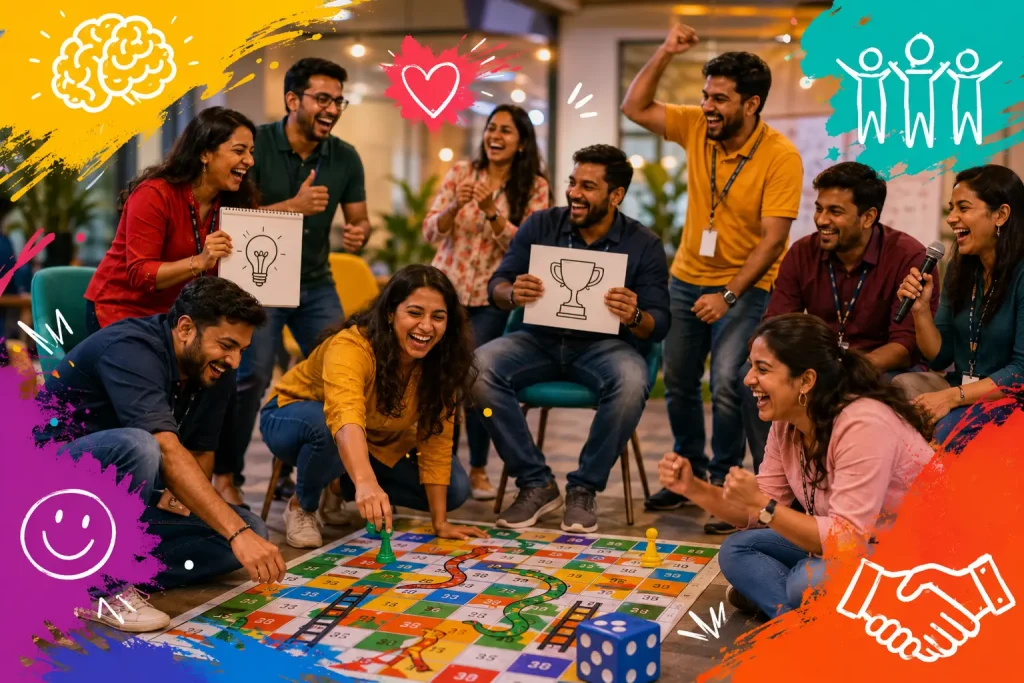
When you introduce a new activity format to a group of adults, you create a brief but real barrier: the ‘what am I supposed to do?’ phase. This phase produces self-consciousness, performance anxiety, and caution — the three things you are trying to dissolve in a team building session.
Games that everyone already knows bypass this phase entirely. The moment you say ‘we’re playing Pictionary’ or ‘we’re doing Antakshari’, people mentally relax. They know the rules. They know roughly how to play. The learning curve is zero — which means engagement begins immediately.
This is also why childhood games carry a specific superpower:
- Snakes & Ladders, Stapoo (Hopscotch), Lagori, Kho Kho — these are wired into muscle memory. Adults who play these stop performing their professional identities within 3 minutes.
- The childhood frame creates a specific emotional permission: ‘I can be silly here.’ That permission is exactly what makes team bonding work.
- There is no skill hierarchy in childhood games — the CEO and the freshest hire are equally good at Stapoo. Hierarchy dissolves faster than in any workshop.
The oxytocin mechanism: Laughter, genuine, unguarded laughter, releases oxytocin, the bonding hormone. Low-cost game formats like Pictionary and Dumb Charades are among the most reliable laughter generators available in a corporate setting. The terrible drawing that everyone can see is funnier than almost anything a comedian could script.
The Activities — A Practical Guide
Pictionary (and Giant Pictionary)
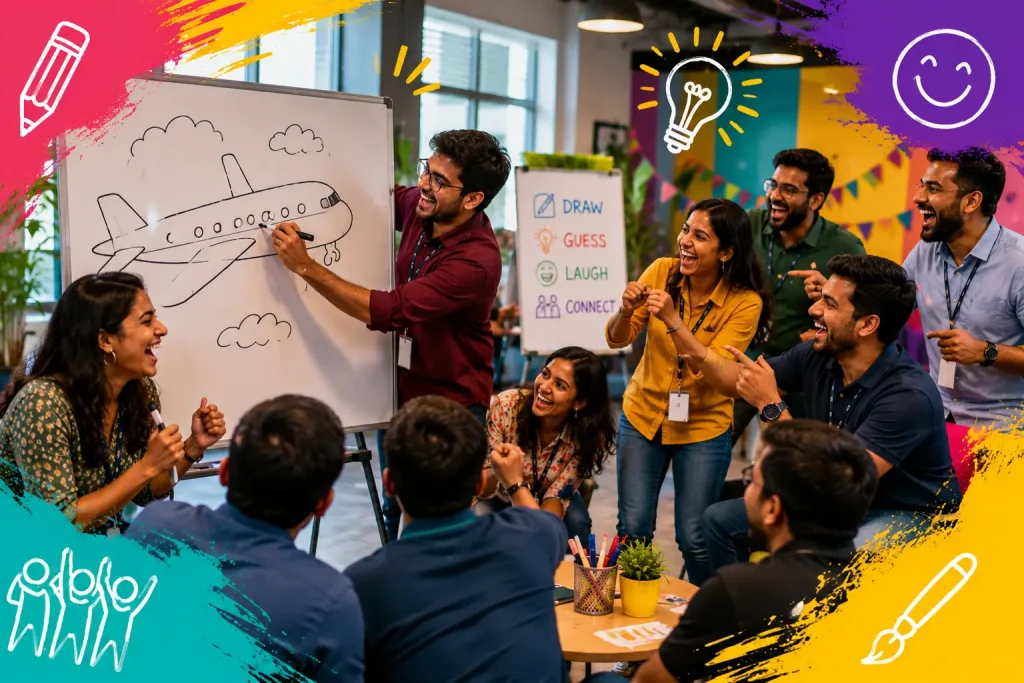
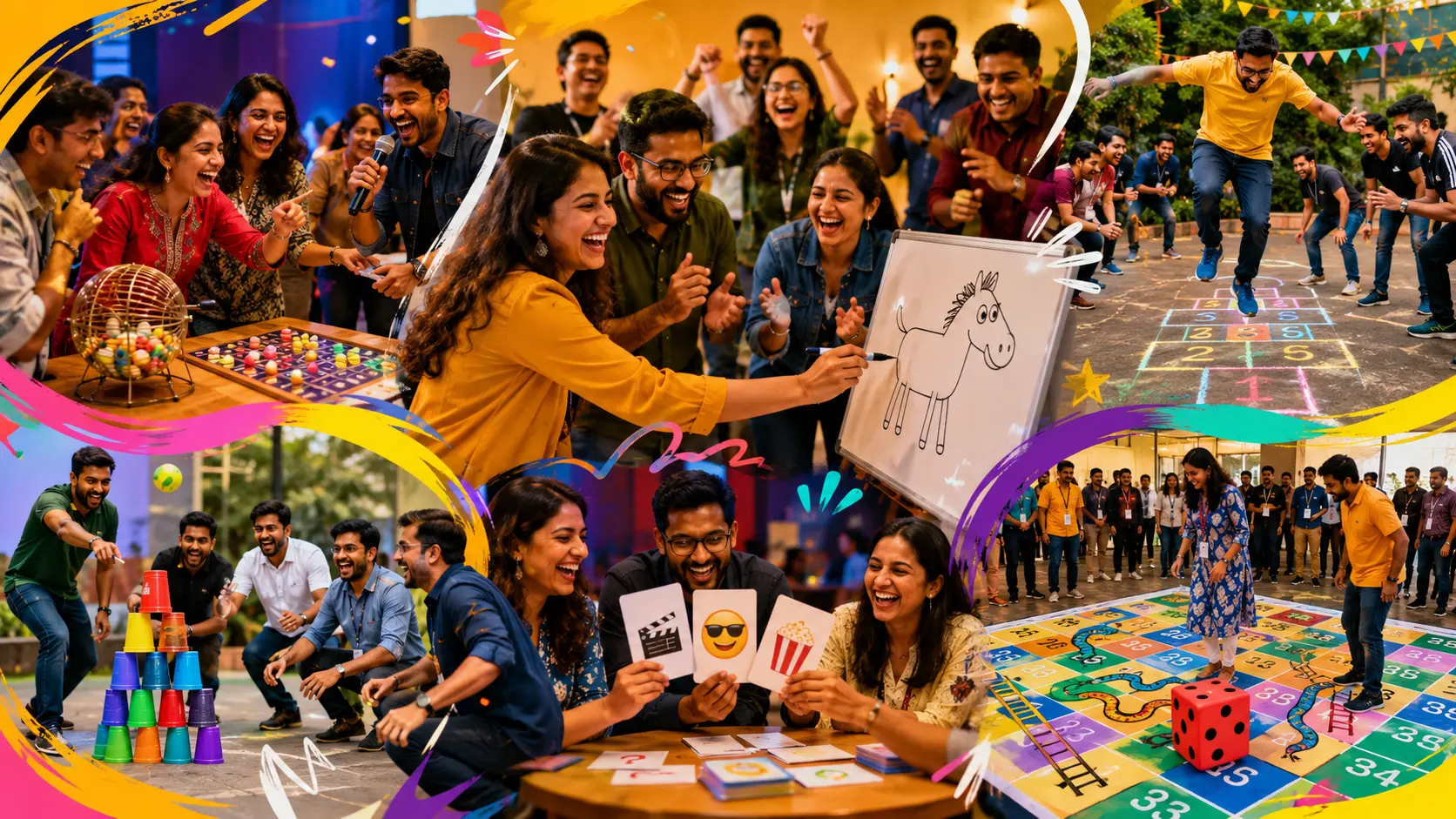
The activity: teams compete to guess what one person is drawing on a whiteboard. Categories: Bollywood movies, office situations, emotions, company products, current events.
Why it works: it doesn’t favour smart, senior, or funny people. The terrible artist who draws a horse that looks like a table becomes the hero of the room. This democratic quality — where your drawing ability is the only skill and that skill is deliberately irrelevant — is exactly what makes it effective.
Cost: ₹0 (whiteboard and marker). Giant format with floor paper or a large flip chart: ₹50–200 total.
Group size: 10–60 people. Scale by adding more teams and rotating drawers.
Want this run professionally for your team? Book full team bonding activity catalogue with engage4more.
Flash Card Games — Movie Quiz, Emoji Guess, Logo Quiz
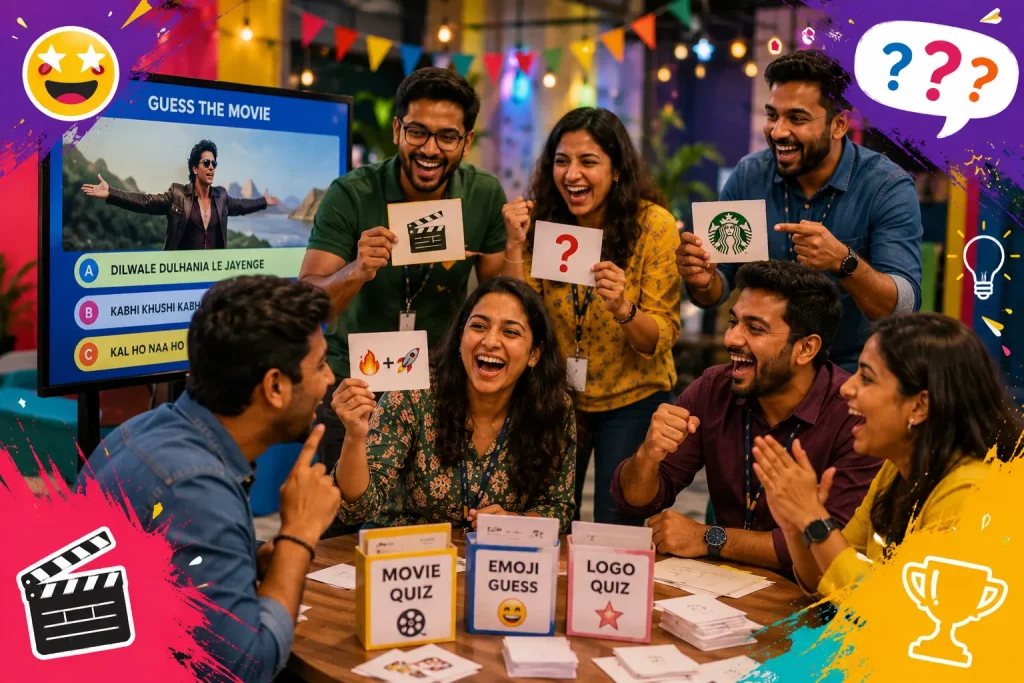
The activity: pre-printed or screen-displayed cards showing partial information (movie stills, emoji combinations, cropped logos, first lines of songs). Teams guess the answer in 30–60 seconds.
Why it works: the content can be hyper-personalised to your team — inside jokes, company references, ‘which colleague said this?’ — which makes every question personal and relevant. Generic quizzes generate polite engagement. Personalised quizzes generate genuine laughter and surprise.
Cost: ₹200–500 for a custom printed card deck. Digital version: ₹0 via Google Slides.
Group size: any size. Works at desks, on Zoom, or in a conference room.
Tambola / Housie
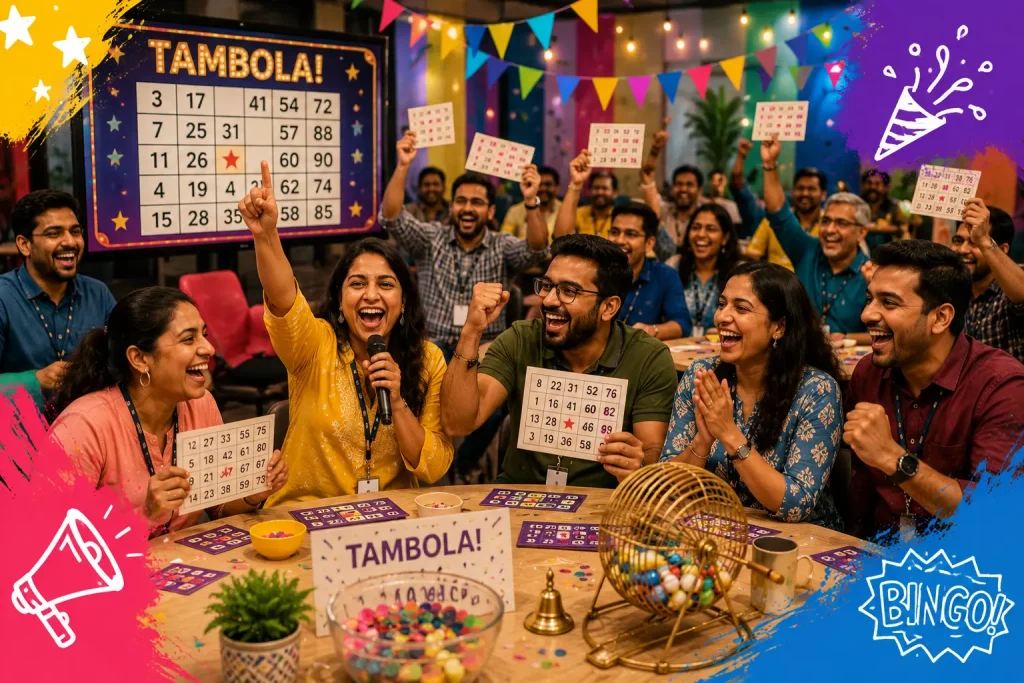
The most democratic game in India. Everyone knows it. No one has a skill advantage. The only variable is luck — which means the CFO and the office assistant are on exactly the same footing for 45 minutes.
Why it works: the collective energy of a room where 40 people are all playing the same game and any one of them might win next is genuinely exciting. The shout of ‘Tambola!’ is one of the most reliably joyful sounds in any office.
Themed variations: Bollywood Tambola (songs instead of numbers), Office Insiders Tambola (company trivia instead of numbers), Festival Tambola.
Cost: ₹200–400 total for printed tickets and tokens. Facilitated Musical Tambola with an MC: ₹200–400 per person with engage4more.
Group size: 20–200 people.
Childhood Games — The Nostalgia Stack
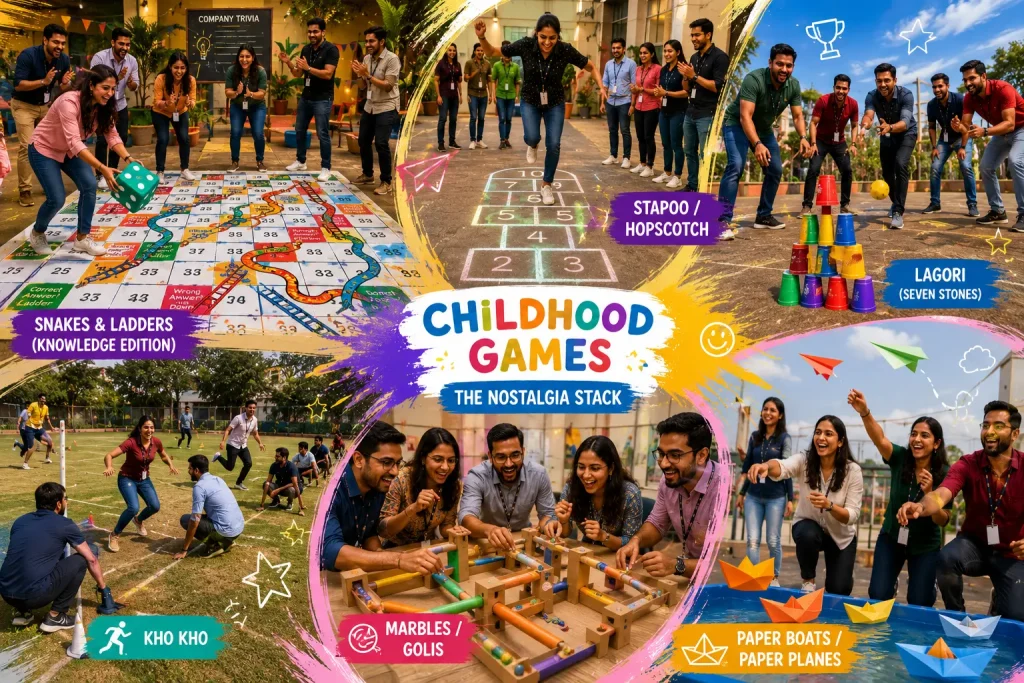
These formats work for any group of Indian adults and cost virtually nothing to run:
| Game | How to Adapt for Office | Space Needed | Cost |
| Snakes & Ladders (Knowledge Edition) | Print a giant vinyl board. Replace squares with company trivia questions — ladder if correct, snake if wrong. | Large open floor or corridor | ₹200–500 (board) + ₹0 for questions |
| Stapoo / Hopscotch | Draw with chalk on parking area or terrace. Add question cards at each square. | Outdoor space or large corridor | ₹0–50 (chalk) |
| Lagori (Seven Stones) | Use a stack of paper cups or foam blocks instead of stones. Two teams. | Outdoor space or large indoor | ₹0–100 |
| Kho Kho | Exactly as is. Works for mixed ages and fitness levels better than most outdoor games. | Open outdoor space | ₹0 |
| Marbles / Golis | Giant marble run competition — teams build courses from cardboard. Creativity + physics. | Any floor space | ₹100–300 (materials) |
| Paper Boats / Paper Planes | Design challenge + distance/accuracy competition. Pure tactile fun. | Any open space | ₹0–50 (A4 paper) |
When Simple Beats Expensive — And When It Doesn’t
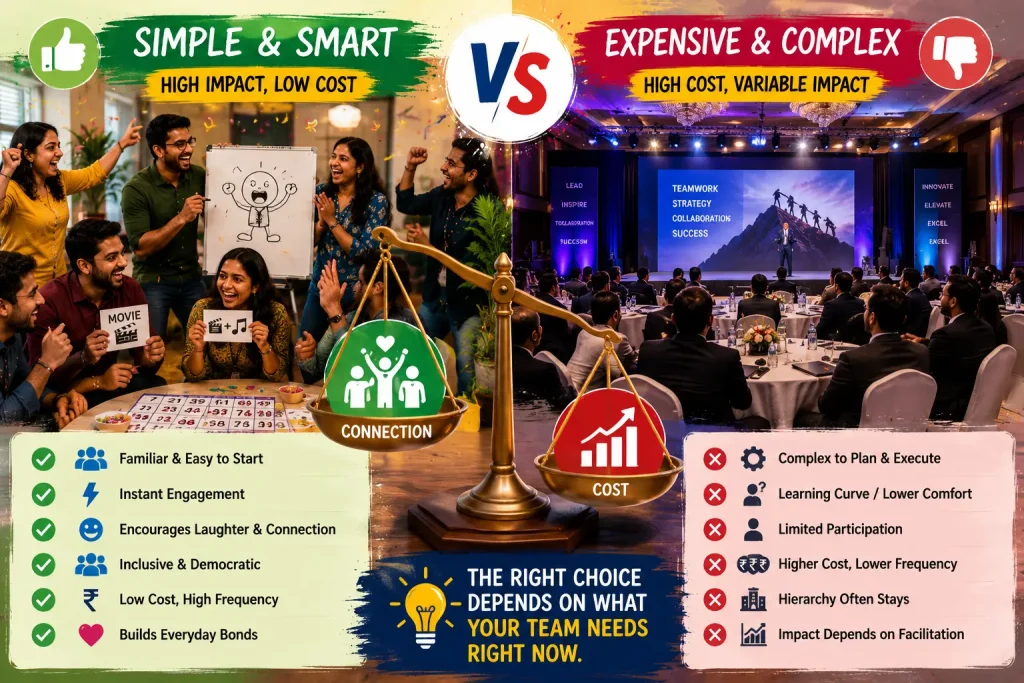
| Choose simple and cheap when… | Consider investing more when… |
| Monthly or bi-weekly cadence — frequency matters more than spectacle | Once-a-year annual day — spectacle is appropriate and expected |
| Post-conflict or low-morale — familiar and safe wins | Post a major milestone — celebration should match the achievement |
| New joiners or mixed groups — icebreaker energy needed | Post-merger integration — deep facilitation produces lasting outcomes |
| Budget is genuinely tight | Budget exists and the team needs a depth experience (e.g. Lifeline) |
| The internal facilitator is strong and energetic | The internal team is stretched — professional facilitation adds real value |
| Team of 10–30 people | Team of 80–200 — production quality and MC energy become essential |
The engage4more honest view: We’ve seen a ₹200/head Antakshari session produce more genuine connection than a ₹2,000/head offsite with a generic team challenge. And we’ve seen a Lifeline Exercise at ₹1,200/head produce outcomes that no game format — however beloved — can replicate. The right activity depends on what your team needs right now. That’s what the MORE² Diagnostic is for.
Powered by S.P.A.R.K.S. — engage4more’s Delivery Methodology. Every activity we facilitate follows S.P.A.R.K.S.: Shared Vision · Principal Values · Altruism · Rules & Policies · Kinship · Smiles & Thrills. This delivery sequence ensures measurable cultural outcomes — not just a good afternoon.
Explore related — book directly with engage4more:
Book Music & Drum Circle activities (Antakshari, Musical Tambola)
Book DEI & Inclusion activities
Book CSR activities
Browse our full Corporate Team Bonding Catalogue
Explore team building activities in your city:
Team Building Activities in Mumbai | Team Building Activities in Delhi NCR | Team Building Activities in Pune | Team Building Activities in Hyderabad | Team Building Activities in Bangalore
Not seeing your city? We deliver pan-India. Reach out to us and our team will design a programme that works for your location, team size, and engagement goals.
Frequently Asked Questions
1. “We have a limited budget for team building. Can we really achieve meaningful results with these low-cost games?”
Answer: Absolutely. The value of team bonding isn’t tied to the price tag of the venue or the complexity of the activity. It’s tied to the level of interaction and shared experience. Low-cost games like Pictionary or Tambola remove the “performance anxiety” often found in expensive workshops, allowing team members to relax and bond authentically. Often, high-frequency, low-cost sessions build more long-term trust than a single, expensive, once-a-year event.
2. “How do I know if my team needs a simple game or a more intensive, professionally facilitated workshop?”
Answer: That’s exactly what the MORE² Diagnostic is for. If your team is struggling with low morale or siloed communication, simple games are the perfect icebreaker. However, if you are navigating a complex post-merger integration, a leadership transition, or deep-seated conflict, those situations require a structured, facilitated approach (like our Lifeline Exercise) to move beyond “having fun” and into “solving structural challenges.”
3. “My team is a mix of senior leaders and fresh graduates. Won’t simple games feel ‘childish’ to them?”
Answer: That is a common concern, but the opposite is usually true. When you play a game like Stapoo or Tambola, the professional hierarchy is briefly suspended. The “fresh hire” and the “CEO” are on equal footing. This “leveling” is actually a powerful leadership tool—it builds psychological safety and reminds everyone that they are human beings first and professionals second.
4. “How often should we run these team bonding activities for the best impact?”
Answer: Frequency beats spectacle. One grand offsite per year creates a “sugar rush” of engagement that fades within weeks. We recommend a “rhythm of connection”—short, 45-minute sessions once a fortnight or monthly. This consistency keeps the team culture healthy year-round and prevents the feeling of being “disconnected” until the next big event.
5. “Can these activities be done if our team is working in a hybrid or remote model?”
Answer: Yes. While some games (like Kho Kho or Lagori) are designed for physical presence, formats like Pictionary, Flash Card Quizzes, and Tambola are easily adapted for digital platforms like Zoom or Microsoft Teams. The goal remains the same: creating a space for non-work-related conversation and laughter.
6. “If we book a professional facilitator from engage4more, what difference does it make compared to doing it ourselves?”
Answer: You can definitely run these games in-house. However, a professional facilitator brings “MC Energy” and objective observation. They ensure that even the shyest team members are included, that the energy never dips, and—most importantly—they help debrief the activity so the “fun” actually translates into a better-performing team. We handle the production so your managers can participate in the fun, rather than having to run it.