

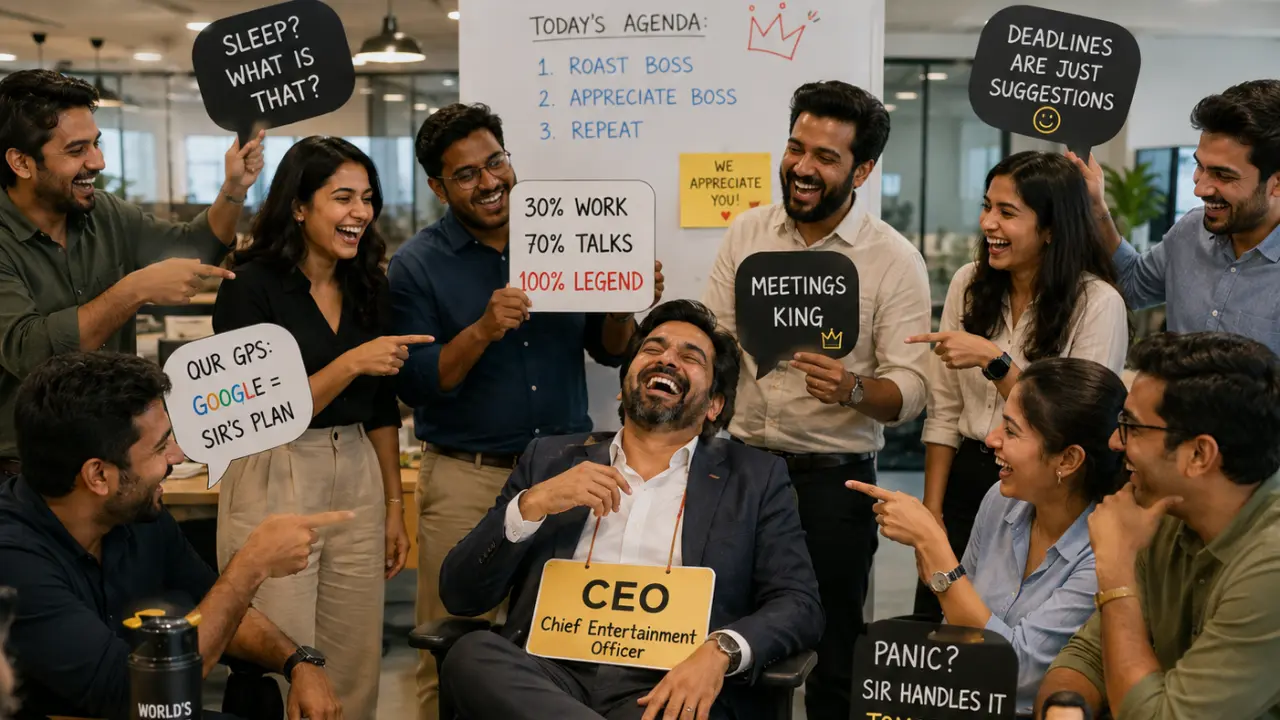
Why Roasting a Senior Can Be the Best Team Building Idea You’ve Ever Had
Done right, a boss roast is a standing ovation for psychological safety. Done wrong, it’s a resignation letter and an HR investigation. Here’s how to be firmly in the first camp.
When a CEO laughs hardest at herself in a room of 60 colleagues — that 45-minute moment does more for team culture than a year of town halls. That’s the power of a well-facilitated boss roast. At engage4more, we’ve run roast-format events for everything from 15-person startups to 200-person banking teams. The format works. But it only works with professional moderation.
Every recommendation here is validated through our MORE² Diagnostic. MORE² identifies whether your team needs Motivation, Onboarding, Reward, or Education, right now. The right activity for a stable, motivated team is completely different from the right one for a newly-formed post-merger team. Learn how the MORE² Diagnostic works.
1. Why a Roast Works — The Psychology
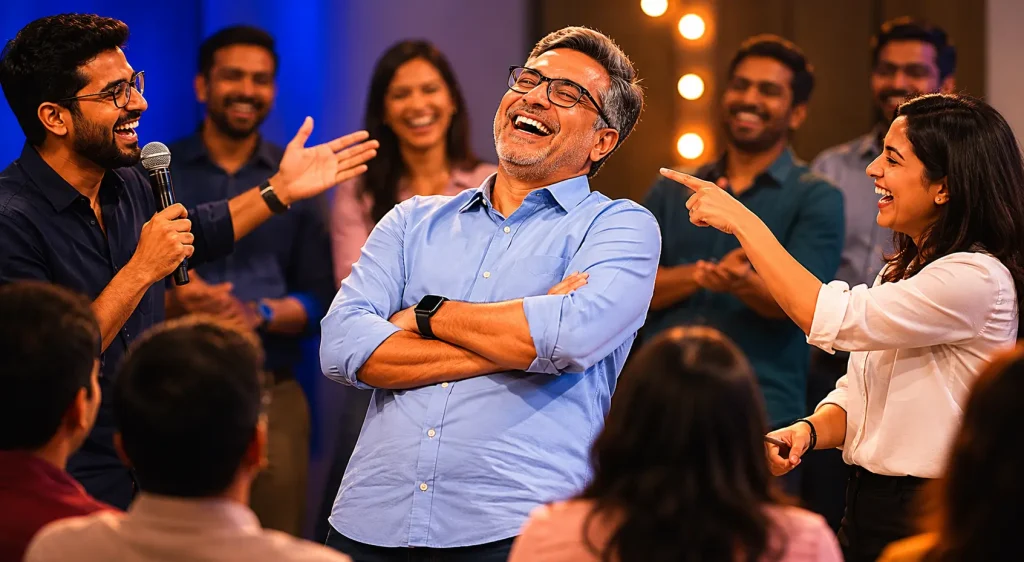
When a senior leader explicitly agrees to be roasted, they give everyone in the room permission to be honest — even if that honesty comes dressed as comedy. Google’s Project Aristotle identified psychological safety as the #1 predictor of high-performing teams. A roast fast-tracks it.
- The senior becomes vulnerable — which makes everyone else safe being vulnerable too
- Shared laughter releases oxytocin — the bonding hormone at scale
- Private frustrations get aired through humour — defusing tension before it festers
- The team sees the leader as human — not just a title on an org chart
The Tony Hsieh principle: Zappos founder Tony Hsieh believed that spontaneous, unscripted moments of shared human experience created more loyalty than any formal programme. In Delivering Happiness, he described how genuine connection, not managed performance, builds culture. A well-run roast is exactly that.
2. The Opportunity — What a Roast Actually Achieves
| Outcome | Why It Happens | Who Benefits Most |
| Breaks hierarchy | When the boss laughs at themselves, the org chart flattens for a day | Mid-level teams, new joiners |
| Creates shared memory | People remember laughter. They’ll reference this event for years. | Entire organisation |
| Surfaces honest feedback | Comedy is a truth-delivery vehicle. Real issues get named safely. | Leadership, HR |
| Builds belonging | Everyone has a voice — including quiet voices | Introverts, remote staff |
| Celebrates the person | A roast is a tribute — ‘we know you well enough to joke’ | The senior being roasted |
3. The Risk Register — Be Brutally Honest Before You Begin
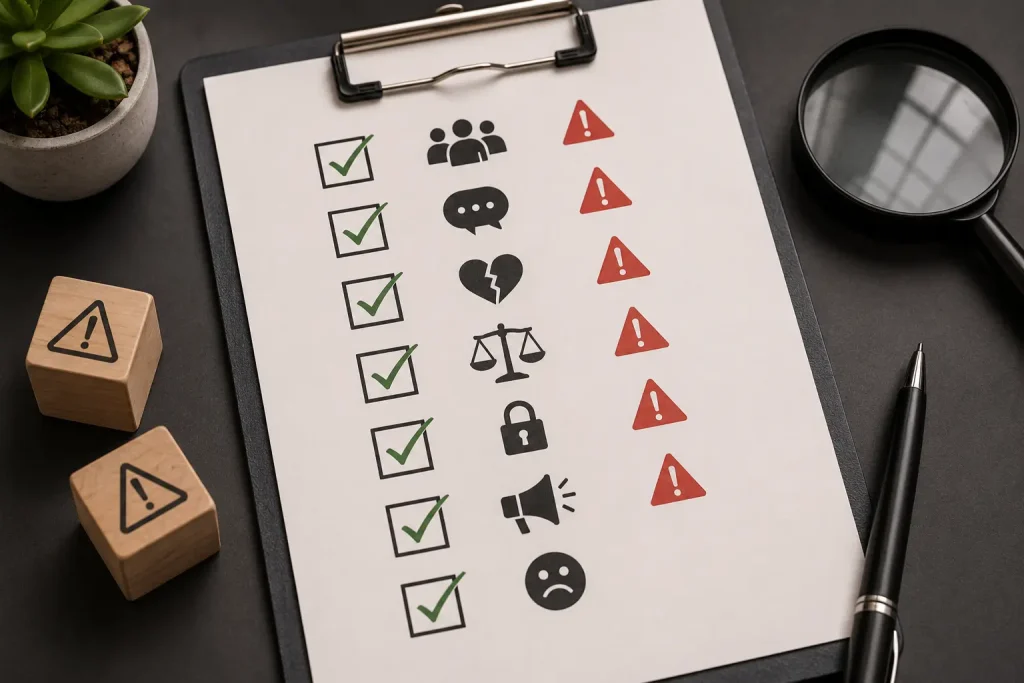
This is the section most guides skip. We won’t.
| Risk | How It Goes Wrong | How to Prevent It |
| Crossing personal/family lines | A roaster mentions marriage, children, health, or finances. Room goes silent. | Brief all roasters in writing: professional moments only. No family, no health, no finances. No exceptions. |
| Gender or minority-sensitive material | A joke lands as sexist, casteist, or racist — even unintentionally. | Professional moderator reviews ALL material 48 hours before. If you have to wonder whether it’s OK, it’s not. |
| The senior doesn’t genuinely laugh | They agreed publicly but felt coerced. Room becomes uncomfortable. | True private consent only — not email, not WhatsApp. If there’s any hesitation, don’t proceed. |
| Power dynamics reversed | Boss roasts juniors back. Or mean content settles scores. | Iron rule via MC: roast goes UP only. Juniors roast seniors. Never the reverse. |
| HR / legal territory | References to PIPs, salaries, or legal matters — even as a joke. | MC’s pre-event script check must flag: performance, salary, termination, legal disputes. |
| Recording goes viral | A clip on LinkedIn lands very differently out of context. | Announce at the start: private event. No external recording. Any internal recap approved by HR first. |
| Wrong team culture | Post-layoff, post-conflict, or low-trust environment. | MORE² Diagnostic must show strong Kinship (K) before recommending this format. Low trust = wrong time. |
The golden rule of roasting: A roast is an act of love, not aggression. If the content would make the person feel worse about themselves after the laughter dies down, it doesn’t belong in the room.
4. Step-by-Step Format
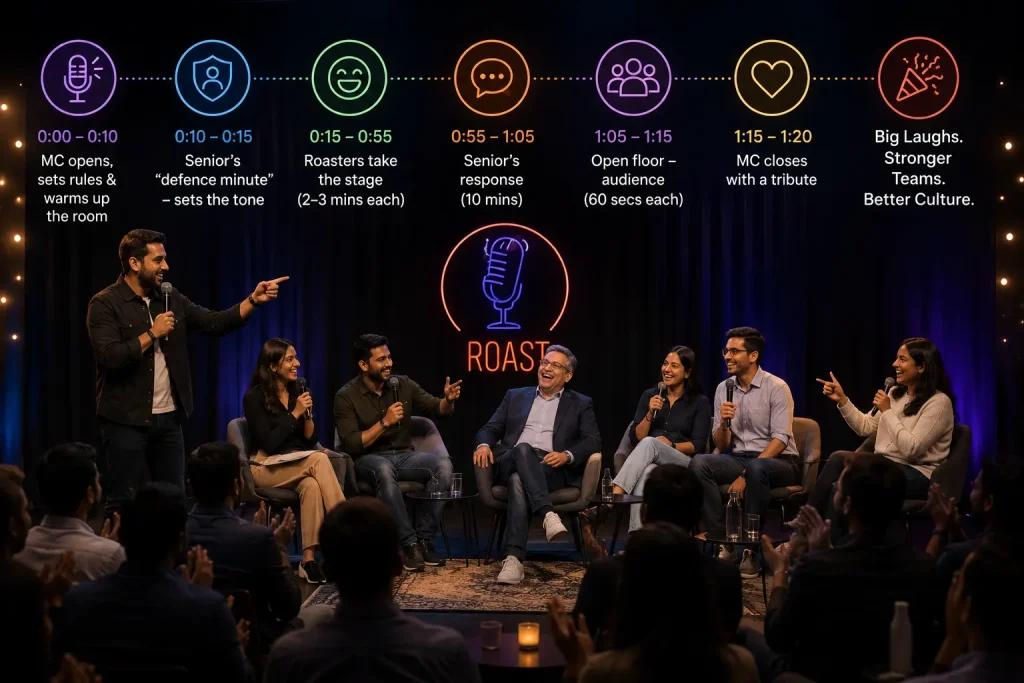
| Time | What Happens | MC’s Role |
| 0:00–0:10 | MC opens, sets rules, warms up the room with 2–3 easy laughs | Sets the tone — irreverent but safe |
| 0:10–0:15 | Senior’s ‘defence minute’ — they name one thing the room will definitely roast them for | Signals genuine consent to the whole audience |
| 0:15–0:55 | Roasters go one by one — 2–3 mins each | Controls pacing, rescues any awkward moment, adds commentary |
| 0:55–1:05 | Senior’s response — 10 minutes to reply to everything | Usually the funniest part. MC watches the room carefully. |
| 1:05–1:15 | Open floor — audience, 60 seconds each, fastest hands first | MC controls tightly. No open-ended contributions. |
| 1:15–1:20 | MC closes — tribute tone, genuine appreciation | Ends on warmth, not a punchline |
Without a professional moderator: The roast stalls on awkward material nobody knows how to navigate. A poorly-timed joke lands in silence. Someone shares something that crosses a line and nobody stops it. The event is remembered for that moment — not the laughter. The moderator IS the safety net. This is not an activity for a volunteer MC.
5. The engage4more Approach
Every engage4more roast engagement includes: pre-event MORE² Diagnostic to confirm cultural readiness, one alignment call with HR and the senior, full script review by our moderator 48 hours before, day-of professional facilitation, and an HR-approved post-event recap.
Our panel includes trained emcees and stand-up comedians who work the corporate circuit across Mumbai, Bengaluru, Delhi, Hyderabad, and Pune. They know exactly where the line is — because they’ve seen both sides of it.
Want this run professionally for your team? Book a stand-up comedian or emcee for your event with engage4more.
6. Not Ready for a Full Roast? Start Here
If the team’s MORE² Diagnostic shows low Kinship, or the culture isn’t ready, these lighter formats build the same psychological safety muscle:
- ‘Confessions of a Manager’ — anonymous cards read by an MC, manager reacts. No names, much lower stakes.
- Office Superlatives — affectionate awards: ‘Most Likely to Reply at 2am’. Celebratory, not combative.
- Hot Seat Q&A — senior answers anonymous audience questions, moderated by an MC. Surprisingly powerful.
Want this run professionally for your team? Book Leadership Development & high-trust team activities with engage4more
Powered by S.P.A.R.K.S. — engage4more’s Delivery Methodology
Every activity we facilitate follows S.P.A.R.K.S.: Shared Vision · Principal Values · Altruism · Rules & Policies · Kinship · Smiles & Thrills. This delivery sequence ensures measurable cultural outcomes — not just a good afternoon. engage4more.com/methodology
Explore related — book directly with engage4more:
Book a stand-up comedian for your corporate event
Book a professional emcee
Browse competitive team activities
Browse our full Corporate Team Building Catalogue
Explore team building activities in your city:
Team Building Activities in Mumbai | Team Building Activities in Delhi NCR | Team Building Activities in Pune | Team Building Activities in Hyderabad | Team Building Activities in Bangalore
Not seeing your city? We deliver pan-India. Reach out to us and our team will design a programme that works for your location, team size, and engagement goals.
FAQs
1. How does a professional roast improve psychological safety in the workplace?
When a leader voluntarily participates in a roast, they demonstrate vulnerability and openness to feedback. This act signals to employees that the organizational culture values transparency and humor over rigid hierarchy. According to studies like Google’s Project Aristotle, psychological safety is the primary predictor of high-performing groups; by using comedy to humanize leadership, you create a safe space for open communication and genuine connection.
2. What are the essential ground rules for hosting a safe office roast?
To ensure an event remains fun and respectful, implement strict guidelines: all content must be pre-approved by a professional moderator 48 hours in advance, and jokes must strictly exclude topics such as family, health, finances, or personal identity. Furthermore, apply the “roast up” rule—only subordinates should roast leadership, never the reverse—to ensure power dynamics remain balanced and positive.
3. Why is professional moderation critical for a leadership roast event?
A professional moderator acts as a vital safety net, ensuring that humor never crosses the line into unprofessional territory or HR-sensitive issues. They manage the pacing, steer the conversation away from awkward topics, and provide immediate intervention if a joke misses the mark. Without an expert facilitator, an unmanaged event risks damaging morale instead of boosting it.
4. How do I know if my company culture is ready for a roast?
Before planning a roast, utilize a diagnostic tool to assess your organization’s current Kinship and trust levels. If your team has recently experienced significant conflict, layoffs, or has low internal trust, a high-intensity format may be inappropriate. In such cases, consider starting with lower-stakes options like anonymous “Confessions of a Manager” or moderated “Hot Seat” Q&A sessions to build the necessary foundation.
5. What are the long-term benefits of shared humor for employee engagement?
Shared laughter triggers the release of oxytocin, the “bonding hormone,” which helps create strong, lasting memories among colleagues. These moments of collective joy flatten hierarchies and help remote or quiet employees feel seen and included. By humanizing management through organized, lighthearted events, companies can significantly increase employee loyalty and foster a more collaborative, connected environment.