






Music Licensing for Corporate Events: The Complete Guide for Indian HR and Event Managers
You think you’re playing music from Spotify. Your employee records a 30-second video. It goes on LinkedIn. Two weeks later, you receive a legal notice. This is not hypothetical — it is happening to companies across India right now.
Music licensing for corporate events is one of the most misunderstood compliance areas in Indian HR. Most companies assume that paying for Spotify Premium or a YouTube subscription covers them for playing that music at an office party, an Antakshari session, or an annual day. It does not. Not even close.
Engage4More has produced 1,000+ music-based corporate events across India — including the CTC (Corporate Talent Championship) Reality Show, one of India’s largest employee music talent competitions. We have navigated the licensing landscape in detail, across every format — live performance, recorded playback, hybrid events, and live-streamed programmes. This guide distils everything we know.
Disclaimer: This is informational content based on our operational experience and publicly available legal information. For specific legal advice, consult a qualified intellectual property lawyer.
Every recommendation here is validated through our MORE² Diagnostic. MORE² identifies whether your team needs Motivation, Onboarding, Reward, or Education, right now. The right activity for a stable, motivated team is completely different from the right one for a newly-formed post-merger team. Learn how the MORE² Diagnostic works.
Why This Matters More Than Ever in 2025

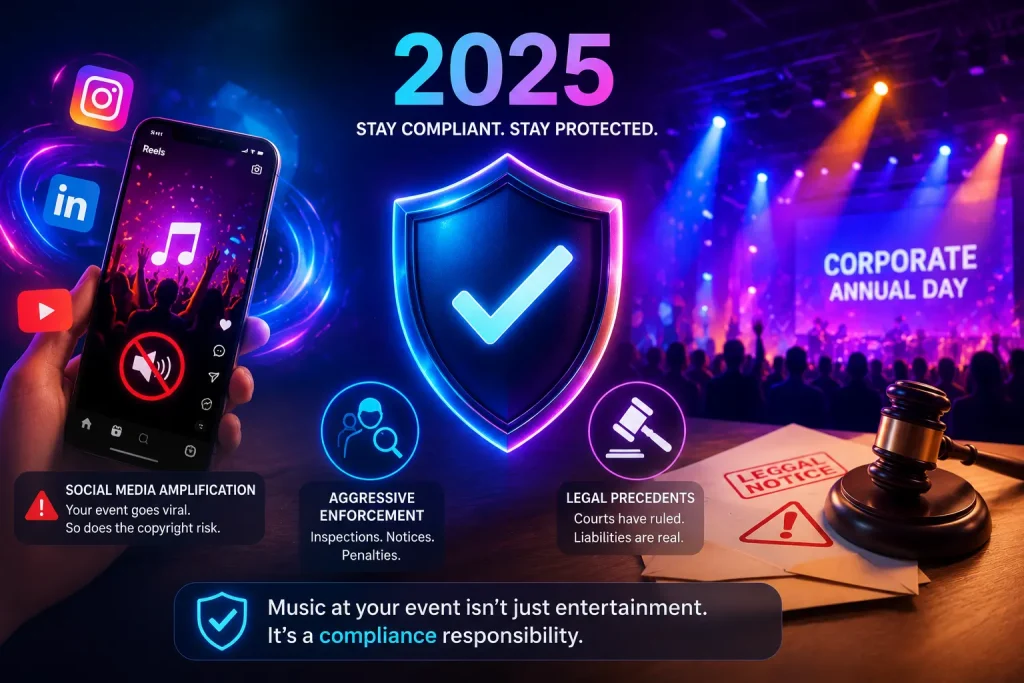
Three things have changed the enforcement landscape dramatically in recent years:
- Social media amplification: When your employee posts a Reel or LinkedIn video from the annual day, any copyrighted music in the background triggers automatic Content ID detection. The platform mutes or removes the video — and in some cases, the rights holder pursues the original organiser.
- Aggressive enforcement networks: PPL, IPRS, NOVEX, and RMPL have built large field networks that actively monitor events, venues, and digital platforms for unlicensed music use. Event organisers in Mumbai, Delhi, Bengaluru, and Hyderabad routinely receive inspection visits.
- Court cases setting precedents: Multiple High Court rulings in 2024–2025 have clarified that corporate events — including office parties, award nights, sales conferences, and even team building sessions — are ‘public performances’ under the Copyright Act, 1957, and require appropriate licensing.
The fundamental legal principle: Under Section 51 of the Copyright Act, 1957, any public communication of a copyrighted sound recording, whether played from Spotify, YouTube, a USB, or a DJ system, requires a licence from the rights holder. ‘Public’ includes any setting beyond a domestic home and private vehicle. Your office party, your Antakshari session, your annual day — all qualify.
The Four Licensing Bodies — Who They Are and What They Cover
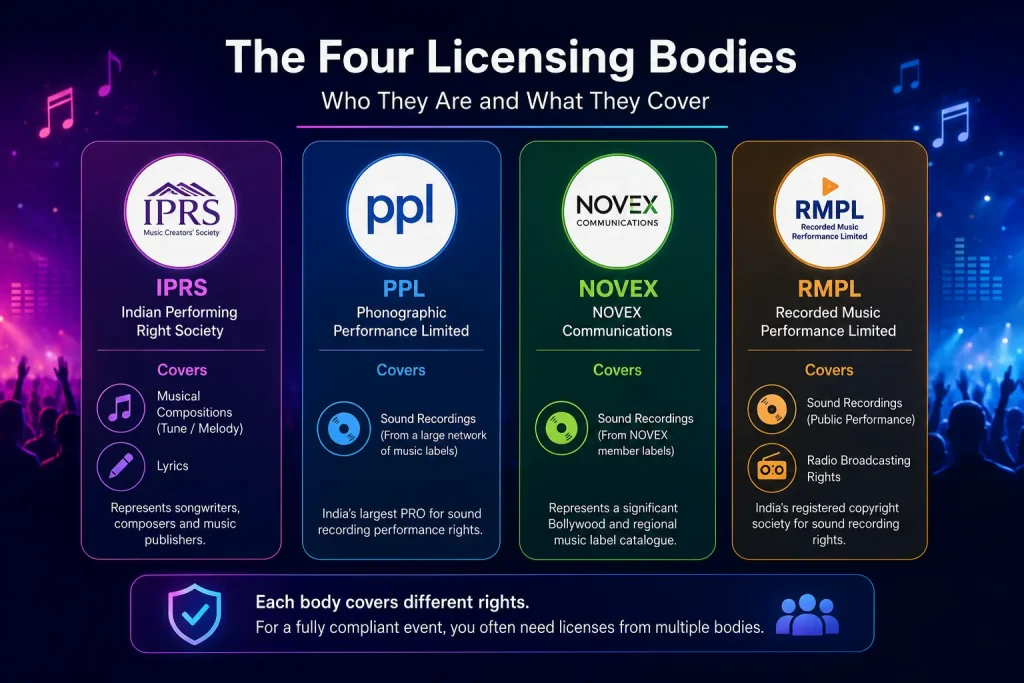
In India, music rights for sound recordings are managed by four primary bodies. The critical — and frequently misunderstood — point is that they cover different rights and different label catalogues. Getting a license from one does not cover you under the others.
IPRS — Indian Performing Right Society
India’s only registered copyright society for musical compositions and lyrics
Governs: The underlying musical composition (tune/melody) and the lyrics of a song. IPRS represents the songwriter, composer, and music publisher — not the record label. If you play any song that has an IPRS member’s tune or lyrics, you need an IPRS licence regardless of which label released it.
Key label members: All major Indian composers, lyricists, and music publishers — including virtually every Bollywood song ever written
Website: iprs.org
Rate card/tariffs: iprs.org/tariffs/ (Live event tariff, Online/hybrid event LSE tariff)
PPL — Phonographic Performance Limited
India’s largest performance rights organisation for sound recordings
Governs: The sound recording (the actual recorded version of the song) — separate from the composition. PPL represents the record labels that produced and own the master recording. Founded in 1941, PPL now manages 7.9 million+ sound recordings across 450+ labels.
Key label members: T-Series · Sony Music Entertainment · Universal Music · Warner Music · Lahari Music · Speed Records · Aditya Music · Venus · and 440+ other labels
Website: pplindia.org
Rate card/tariffs: pplindia.org/tariffs (revised effective April 1, 2025)
NOVEX Communications
Public performance rights organisation representing a significant Bollywood catalogue
Governs: Sound recording public performance rights for its member labels — a separate and significant catalogue from PPL. NOVEX is not a registered copyright society (unlike IPRS and RMPL), but operates as a direct representative of its label members under contract.
Key label members: Saregama (India’s oldest label, pre-independence catalogue) · Yash Raj Films · Tips Music · Zee Music Company · Think Music (SPI) · Red Ribbon Entertainment · Daler Mehndi (DRecords) · Gurdas Maan · Mika Singh · Kalamkaar Music
Website: novex.in
Rate card/tariffs: novex.in/wp-content/uploads/2025/07/Events_Rate_Card_WB.pdf (effective July 2025)
RMPL — Recorded Music Performance Limited
India’s registered copyright society for sound recording public performance rights
Governs: Sound recording public performance and radio broadcasting rights for its member music labels. Registered as a copyright society by the Registrar of Copyrights in June 2021 — making it the only government-registered body for sound recording licensing (PPL’s application remains pending as of 2025). A landmark Delhi High Court ruling in 2025 held that PPL must become an RMPL member to license its catalogue — a ruling currently under Supreme Court review.
Key label members: Multiple non-film and film music labels across regional and national markets
Website: rmplindia.org
Rate card/tariffs: rmplindia.org (contact for tariff schedule)
The practical implication — you likely need multiple licences: A typical Bollywood-themed Antakshari or Musical Tambola at your office will use songs from multiple catalogues. Songs from the 1990s (Saregama) need NOVEX. Songs from current T-Series films need PPL. The underlying composition of every song needs IPRS. For a hybrid or live-streamed event, you need the streaming equivalent of each licence too. This is why most companies running music events without specialist support are unknowingly exposed.
The Saregama–PPL Split — A 2025 Shake-Up Every Event Manager Should Know
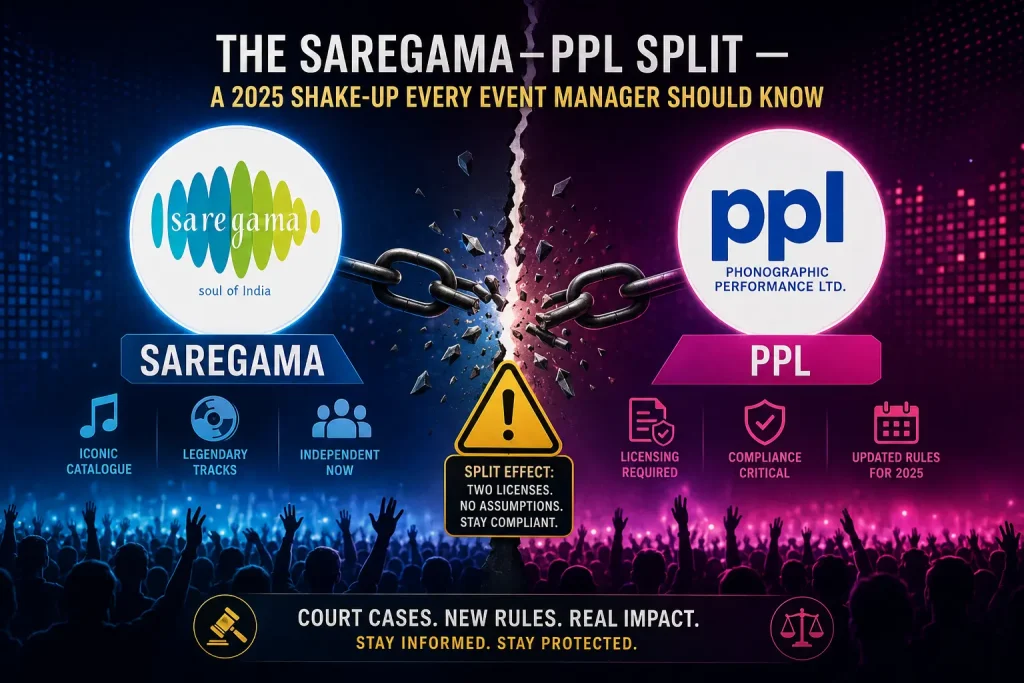
Until early 2025, Saregama — India’s oldest music label, owner of decades of Hindi, regional, and classical music, was represented by PPL for public performance rights. This meant a single PPL licence covered a massive swathe of Indian music history.
That changed. Saregama exited PPL and moved its catalogue to NOVEX Communications for public performance rights. This single change has significant practical implications:
- Any corporate event playing pre-1990s Bollywood classics, old Hindi film songs, or Saregama’s extensive regional catalogue now requires a NOVEX licence — not PPL.
- Event planners who relied on PPL alone for historical Indian music are now exposed without realising it.
- The Delhi High Court’s 2025 ruling that PPL must licence through RMPL is currently stayed by the Supreme Court, creating ongoing legal uncertainty about the precise relationship between PPL and RMPL.
The honest summary of the current situation: India’s music licensing landscape in 2025 is genuinely complex and in active legal flux. The safest approach for a corporate event is to obtain licences from IPRS (for all compositions) + PPL (for their current catalogue) + NOVEX (for Saregama, YRF, Tips, Zee Music, and others), and take professional advice on RMPL depending on your specific event scope. This is exactly why engage4more maintains current licences across all bodies for the events we produce.
Online, Hybrid, and Live-Streamed Events — A Separate Licence Stack
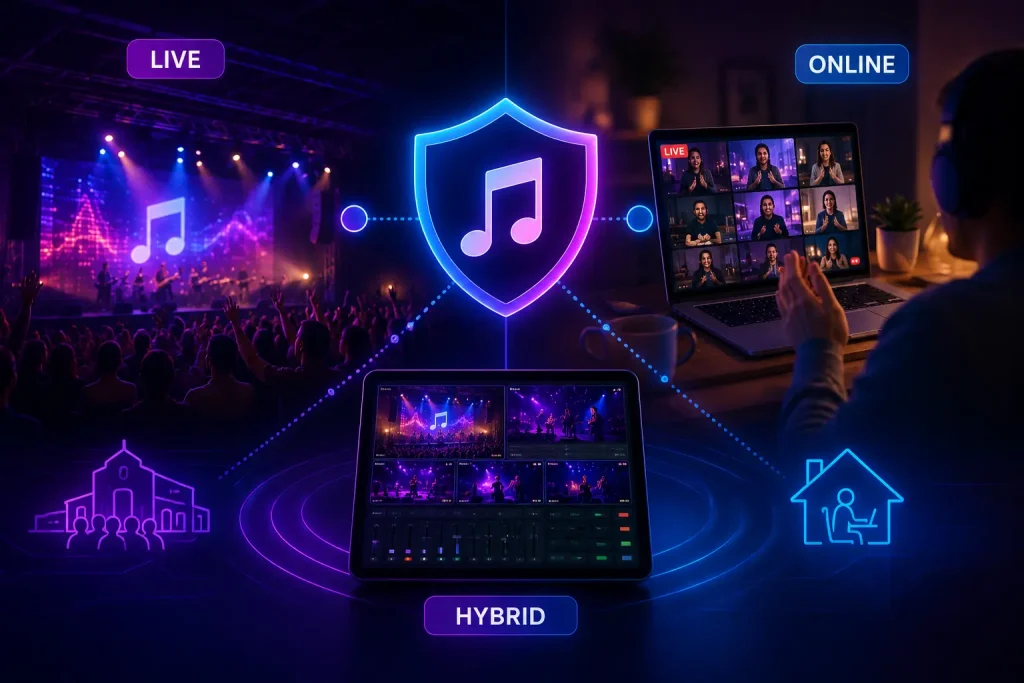
Here is where most companies are most exposed. An in-person event and its live stream or recording are legally distinct uses requiring separate licences.
| Scenario | What You Need | Why |
| In-person event only (no recording, no stream) | IPRS Events Licence + PPL Events Licence + NOVEX Events Licence | Playing music publicly in a venue = public performance. All three cover different rights. |
| Event recorded and shared internally (WhatsApp, company intranet) | Same as above. Internal sharing still constitutes reproduction of a sound recording. | The Copyright Act covers reproduction regardless of audience size. ‘Private’ internal sharing is not a legal defence. |
| Event live-streamed on Zoom / Teams for remote employees | IPRS LSE Tariff (Live Streaming of Online Events) + PPL streaming licence + NOVEX streaming rights | The live stream is a separate ‘communication to the public’ — requiring a distinct licence even if only employees watch. |
| Event live-streamed on YouTube / Facebook Live | IPRS LSE Tariff + platform’s existing music agreements may partially cover you — but NOT completely. YouTube’s Content ID will flag and mute copyrighted music regardless. | YouTube and Facebook have blanket deals with some rights holders but not all. Your stream may be partially muted, partially blocked, or result in a claim against your account. |
| Recorded video posted publicly (YouTube, LinkedIn, Instagram Reels) | Synchronisation licence required (separate from performance licence) + all of the above. | Sync rights cover music used alongside video. This is a completely separate right from public performance — and one that YouTube, Instagram, and LinkedIn will automatically flag via Content ID. |
The Wedding Exemption — What the Courts Have Said
This section is relevant because many HR teams assume that if weddings can use music without licences, office parties and celebrations should similarly be exempt. This is incorrect.
What Section 52(1)(za) says
The Copyright Act, 1957 includes an exemption under Section 52(1)(za) for ‘the performance of a literary, dramatic or musical work or the communication to the public of such work or of a sound recording in the course of any bona fide religious ceremony or an official ceremony.’ The explanation clarifies that ‘religious ceremony’ includes ‘a marriage procession and other social festivities associated with a marriage.’
The legal history — a contested landscape
- DPIIT Notice (July 2023): The Department for Promotion of Industry and Internal Trade issued a notice confirming that marriages and associated functions fall under the Section 52(1)(za) exemption — directing copyright societies not to demand licences for such events.
- Delhi HC Interim Order (January 2024): In Canvas Communication vs. Phonographic Performance Limited, the Delhi High Court directed the plaintiff to deposit fees for wedding events as an interim measure — without ruling definitively on the exemption. This created significant legal uncertainty.
- Bombay HC (August 2024): The Bombay High Court quashed a Goa government circular that had sought to exempt wedding music from licensing requirements — holding that executive notices cannot override statutory copyright rights.
- Supreme Court — IPRS vs. Sanjay Dalia (2015): The Supreme Court held that playing music at marriage functions in commercial venues (hotels, banquet halls, lawns) constitutes public performance requiring permission from rights holders.
The bottom line on weddings: The wedding exemption under Section 52(1)(za) remains legally contested as of 2025. It may apply to genuinely private, non-commercial ceremonies at home — but music played in hotels, banquet halls, or commercial venues for weddings requires licensing, per multiple court rulings. And crucially, none of this applies to corporate events. Office parties, team building sessions, annual days, and employee engagement events are commercial events — the exemption does not apply.
The Penalties — Why This Is Not a Risk Worth Taking
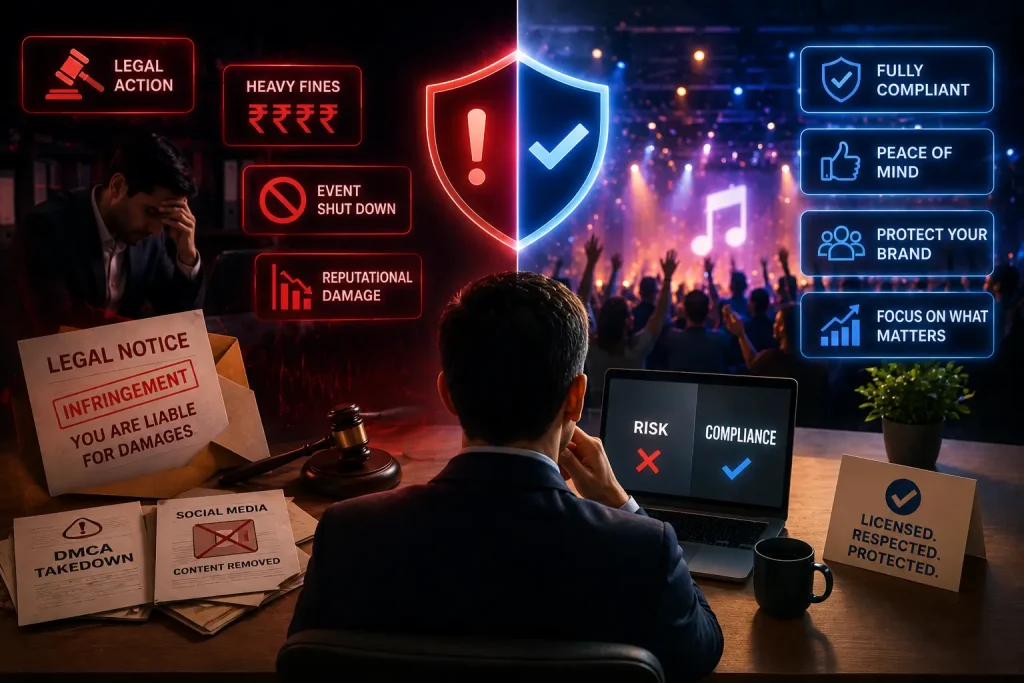
Under the Copyright Act, 1957, playing copyrighted music without a licence is a criminal offence — not just a civil matter. Here is the penalty structure:
| Section | Offence | Penalty |
| Section 63 (first offence) | Knowingly infringes or abets infringement of copyright in any work | Imprisonment: minimum 6 months, up to 3 years Fine: minimum ₹50,000, up to ₹2,00,000 |
| Section 63A (repeat offence) | Second or subsequent conviction for copyright infringement | Imprisonment: minimum 1 year, up to 3 years Fine: minimum ₹1,00,000, up to ₹2,00,000 |
| Civil liability | Rights holder sues for damages in civil court | Actual damages + any profits earned from the infringing use + court’s discretionary additional damages |
| IPRS penalty surcharge | Non-compliant licensees seeking to regularise past infringement | 30% surcharge above existing tariff rates, at IPRS discretion |
| IPRS streaming penalty | Non-compliance for live streaming events seeking to regularise | Minimum 50% additional fee above existing LSE tariff rates |
| Seizure powers | Section 64 — police officer of sub-inspector rank or above | Can seize infringing equipment without a warrant if copyright offence suspected. No court order required. |
The enforcement network — do not underestimate it: PPL, IPRS, and NOVEX maintain active field teams that visit events, hotels, venues, and corporate offices. They monitor LinkedIn, Instagram, and YouTube for unlicensed event content. They use automated Content ID systems on digital platforms. The Delhi High Court’s 2025 ruling against PPL for ‘arbitrary tariffs’ (the Al-Hamd case, May 2025) shows courts are willing to scrutinise their practices — but this does not make unlicensed use legal. The enforcement machinery is real, active, and growing.
Activities That Typically Require Licensing — and What engage4more Does

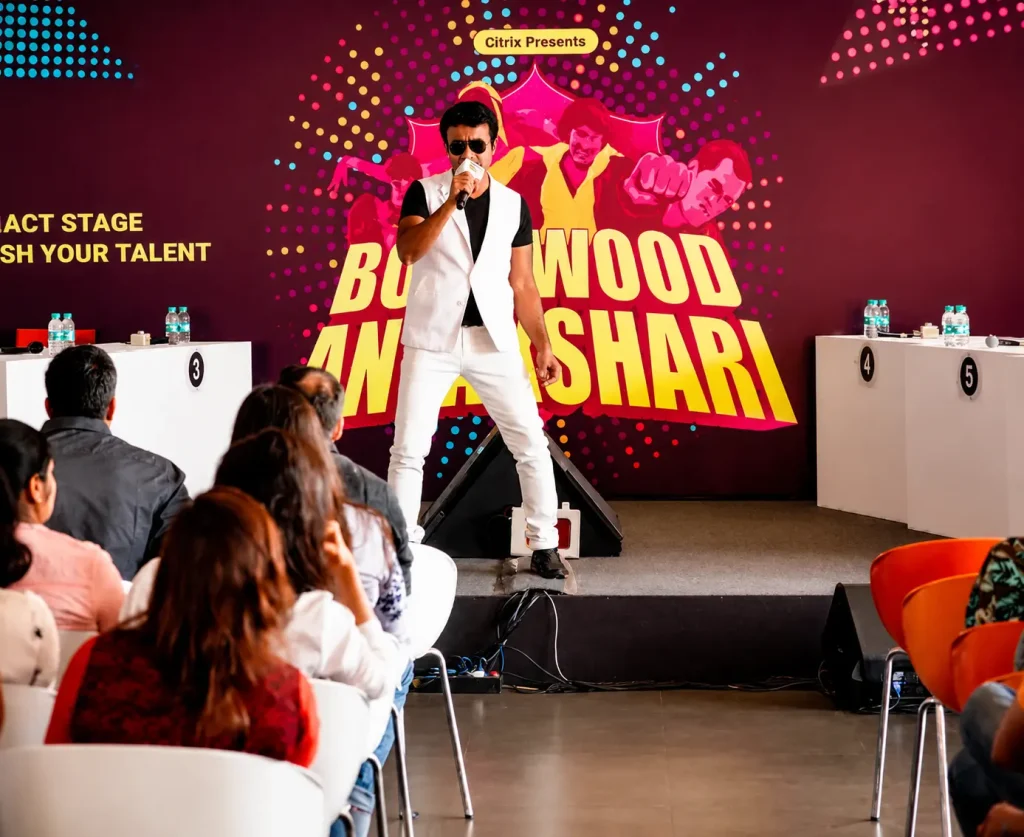
Every music-based activity we list in our catalogue triggers licensing requirements. Here’s an honest breakdown:
| Activity | Licences Typically Required | Engage4More’s Approach |
| Antakshari | IPRS (compositions) + PPL and/or NOVEX (sound recordings if any are played) | We hold current event licences across bodies. All engage4more Antakshari sessions are covered. |
| Musical Tambola | IPRS + PPL + NOVEX (song clips played during the game) | All song clips used in engage4more Musical Tambola are from licensed catalogues. |
| War of Bands / Singing Competition | IPRS (compositions performed) + PPL/NOVEX (if original recordings played as backing tracks) | engage4more advises clients on backing track usage. Original recordings require additional clearance. |
| DJ Night / Dance Party | IPRS + PPL + NOVEX (comprehensive coverage needed for DJ sets) | DJ sets should use licenced sets or original compositions. engage4more production team advises on compliant formats. |
| Hybrid event with live stream | All of the above + IPRS LSE Tariff + PPL/NOVEX streaming rights | engage4more’s production team designs hybrid events with streaming compliance built in from the brief stage. |
| LinkedIn/YouTube post of event highlights | Sync rights required (from each label individually) — typically not covered by event licences | engage4more advises clients to use original music or Creative Commons music in any posted content, or obtain sync clearances. |
Our Credential in This Space
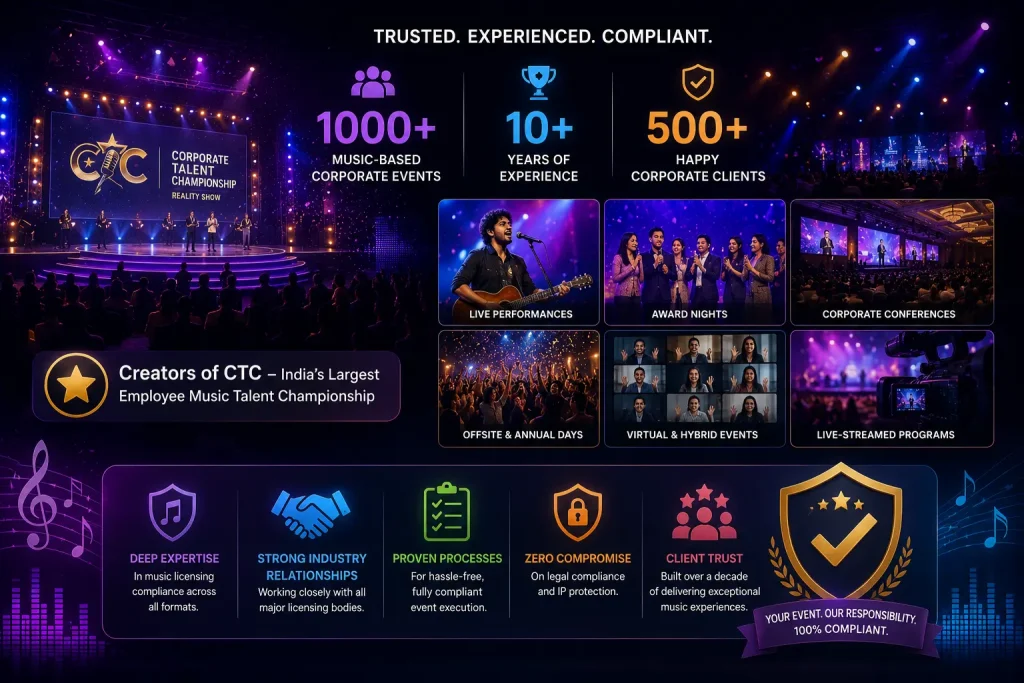
engage4more produced the CTC (Corporate Talent Championship) Reality Show — a large-format employee music talent competition across corporate offices. Running a show of this scale — with live singing, recorded backing tracks, broadcast elements, and social media distribution — required us to work through the full licensing stack across IPRS, PPL, and NOVEX in detail.
That experience is what informs every music activity we design today. When you book an Antakshari, a Musical Tambola, or a War of Bands through Engage4More, the licensing compliance is built into the engagement from the start — not added as an afterthought. We’ve lived this. We know the cost of getting it wrong.
The engage4more licensing principle: We believe the creative output of every Indian songwriter, composer, singer, and producer deserves to be compensated. Licensing is not bureaucracy — it is the mechanism that sustains the music industry that makes all our events possible. We pay for it. And we build that cost transparently into our quotes.
Quick Reference — Licensing Body URLs
| Body | Website | Tariff / Rate Card | Contact for Events |
| IPRS | iprs.org | iprs.org/tariffs | iprs.org/get-your-license |
| PPL India | pplindia.org | pplindia.org/tariffs (revised April 2025) | pplindia.org/contact |
| NOVEX | novex.in | novex.in/wp-content/uploads/2025/07/Events_Rate_Card_WB.pdf (effective July 2025) | novex.in/faq |
| RMPL | rmplindia.org | Contact RMPL directly | corporate@rmplindia.org |
Powered by S.P.A.R.K.S. — engage4more’s Delivery Methodology. Every activity we facilitate follows S.P.A.R.K.S.: Shared Vision · Principal Values · Altruism · Rules & Policies · Kinship · Smiles & Thrills. This delivery sequence ensures measurable cultural outcomes — not just a good afternoon.
Explore related — book directly with engage4more:
Book Music & Drum Circle activities — all licences included
Book Musical Tambola for your office
Browse our full Corporate Team Building Catalogue
Explore team building activities in your city:
Team Building Activities in Mumbai | Team Building Activities in Delhi NCR | Team Building Activities in Pune | Team Building Activities in Hyderabad | Team Building Activities in Bangalore
Not seeing your city? We deliver pan-India. Reach out to us and our team will design a programme that works for your location, team size, and engagement goals.
FAQs
1. Does a Spotify or YouTube subscription allow me to play music at my office event?
No. Subscriptions like Spotify Premium, YouTube Music, or Apple Music are strictly for personal, non-commercial use only. Using a personal account to play music at an office party, award function, or any corporate gathering constitutes a “public performance” under the Copyright Act, 1957. To play music in a corporate setting, you must obtain specific public performance licences from the relevant copyright societies (IPRS, PPL, NOVEX, and potentially RMPL).
2. Why do I need multiple licences for one event?
Music rights in India are fragmented. Most corporate events involve a mix of underlying compositions (lyrics and melody) and the actual sound recording (the master track).
-
IPRS covers the songwriters, composers, and lyricists.
-
PPL, NOVEX, and RMPL cover the master sound recordings owned by various music labels. Because different labels are represented by different organizations, and because compositions and recordings are distinct legal rights, a single licence rarely covers your entire event playlist.
3. Does the “wedding exemption” apply to corporate events?
No. There is a common misconception that because some weddings may be exempt from licensing, corporate functions are also exempt. The legal exemption under Section 52(1)(za) of the Copyright Act is highly specific to “bona fide religious ceremonies” and associated social festivities. Corporate events, including office parties, offsites, and award nights, are classified as commercial events, and the law clearly mandates that they require appropriate music licensing.
4. Are online and hybrid events subject to the same licensing rules?
Actually, they are more complex. An in-person event requires a public performance licence. However, if you live-stream that event on platforms like Zoom, Microsoft Teams, or YouTube, you are performing an additional act of “communication to the public” over the internet. This requires separate digital/streaming licences (such as the IPRS LSE tariff) in addition to your standard event licences.
5. What happens if an employee posts a video of our event on LinkedIn?
When an employee uploads a video of your event to social media, they are effectively distributing a recorded version of the music. This triggers two major risks:
-
Content ID Detection: Platforms like LinkedIn, Instagram, and YouTube use automated systems to detect copyrighted music, which often results in the video being muted, blocked, or your account receiving a copyright strike.
-
Legal Liability: In addition to platform-level takedowns, the rights holders can legally pursue the event organizer for unauthorized reproduction and public distribution of their music.
6. Can I be held criminally liable for playing unlicensed music at work?
Yes. Under the Copyright Act, 1957, music piracy or unauthorized public performance is a criminal offence. Section 63 of the Act prescribes penalties including imprisonment ranging from six months to three years, and fines ranging from ₹50,000 to ₹2,00,000. Furthermore, under Section 64, police officers have the authority to seize the equipment being used for the infringing performance without a warrant.