







A comedy show is not fiction. It is a live event with a microphone, a room full of unpredictable people, and a performer whose entire job depends on reading both correctly in real time. When it works, it is one of the most memorable parts of any corporate event calendar. When it doesn’t, the reasons are almost always preventable — and almost always come down to planning, not talent.
Planning your first — or fiftieth — corporate comedy show? Every mistake in this guide is preventable with the right comedian and the right briefing process. Browse India’s top comedians and book for your event — or explore budget-friendly comedian options for high-quality shows at accessible prices.
After fifteen years of booking comedy for corporate India, engage4more has seen every version of what can go wrong: the mic that cuts out mid-punchline, the comedian briefed by three different people with three different instructions, the content written for a college fest performed at a boardroom dinner. None of these are mysteries. They are checklist items.
This guide breaks down thirteen of the most common failure points across three categories — technical and logistical planning, audience management, and artist briefing — with the fix for each one. If you are organising a corporate comedy show, treat this as your pre-event checklist.
Part 1: Technical and Logistical Planning

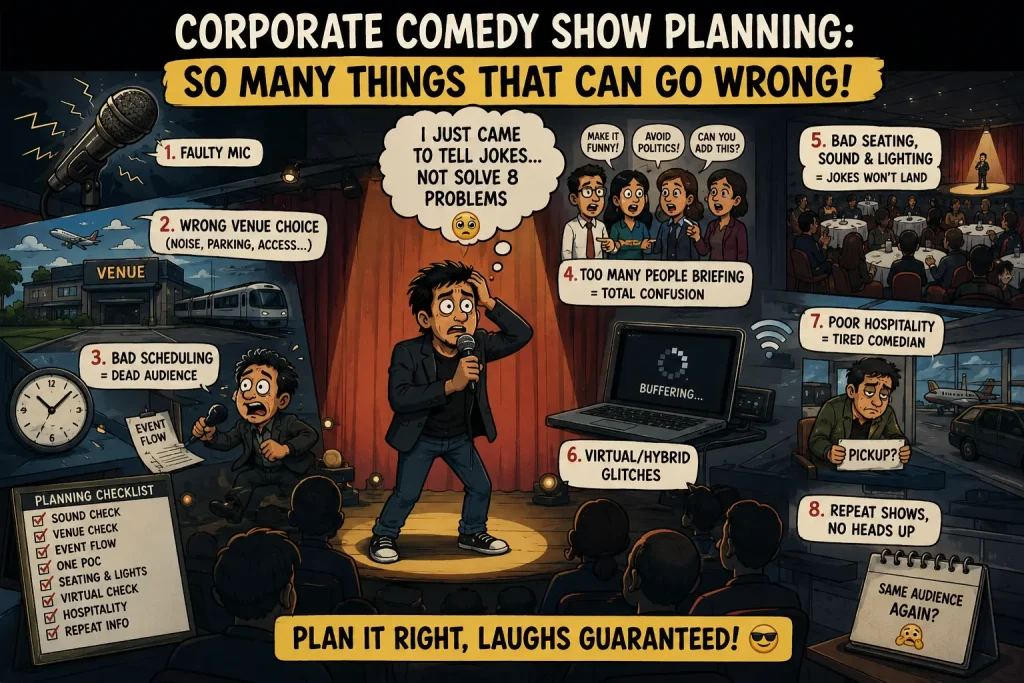
These are the mistakes that originate with the organising team — venue choice, scheduling, technical setup — rather than with the performer. They are also the most preventable, because they can all be checked in advance.
1. A Faulty Mic Can Derail an Otherwise Perfect Set
Even with proper checks, technical failures happen. A mic that cuts out mid-performance is not the comedian’s fault, but it wastes time and can rattle even an experienced performer. A full sound check and backup mic drill before the comedian goes live is non-negotiable — not an optional extra.
2. The Venue Deserves the Same Scrutiny as the Comedian
The venue is one of the most disaster-prone variables in the entire event. Location matters: avoid venues near airports or railway stations where ambient noise can disrupt the performance. Parking matters: limited parking creates frustrated, late-arriving guests who walk in mid-set. Before confirming any venue, walk through every detail with the venue administrator — stage dimensions, seating layout, washroom access, and backup power. Don’t assume; verify.
3. When Comedy Is Part of a Larger Event, Scheduling Decides the Mood in the Room
A restless audience is a comedian’s hardest audience. If a comedy segment follows a music performance or another programme element, that segment must not run long — by the time the comedian takes the stage, audience energy may have already peaked and started to decline. Build a detailed event flow that accounts for how each element either builds or drains audience excitement before the comedian arrives. For corporate events specifically, finish on time: a comedy set that runs into the bar-opening window or the dinner service will lose the room regardless of how good the material is.
4. One Point of Contact for Briefing — Not Three
Confusing a comedian with multiple, conflicting inputs from different stakeholders is one of the most avoidable mistakes an organising team can make. A comedian preparing for a corporate show already has a great deal to manage. Designate a single person to handle all briefing communication, and keep star-struck team members out of the briefing room — enthusiastic but unstructured input from people who aren’t responsible for the show’s content tends to create confusion rather than clarity. For a complete framework on how to brief a comedian correctly the first time, see
our P.U.N.C.H.Y. Framework guide — engage4more’s proprietary method covering Personality Fit, Unheard Material, No-Go Zones, Cost Clarity, Hook & Flow, and the ‘Yes, And’ Rehearsal.
5. Seating, Sound Reach, and Lighting Decide Whether the Room Can Actually Hear the Joke
If the audience is seated too far from the stage, or the mic’s reach doesn’t cover the room, the connection between comedian and audience simply doesn’t happen. Round-table seating makes it difficult for a comedian to engage directly with the crowd — theatre-style seating, with everyone facing the stage, works best for comedy specifically. Lighting matters too: audiences laugh more freely in a dark room with a spotlight on the performer than in a fully lit one where they feel watched. This mistake is especially common at corporate shows, where unfamiliar venues and tight setup windows leave little time to test and correct the room before the audience arrives.
6. Virtual and Hybrid Shows Need Their Own Checklist
Virtual and hybrid comedy formats have matured significantly since they first became common, but they still fail for the same basic reasons: unstable connectivity, scripts that haven’t been reviewed jointly by the organiser and comedian beforehand, and a platform setup that doesn’t preserve the in-person energy a comedy performance depends on. A strong, tested internet connection at both ends, a full script walkthrough in advance, and attention to how the platform handles audience reactions (so the comedian isn’t performing into silence) are the baseline requirements for any virtual or hybrid comedy booking.
7. Hospitality Sets the Tone Before the Comedian Even Reaches the Stage
How an artist is received and looked after is, in a very real sense, where the show begins. Airport pickup, punctual arrival at the venue, and attention to the comedian’s specific needs all shape the mental state they walk on stage with. A well-handled hospitality experience produces a relaxed, focused performer. A poorly handled one introduces avoidable risk into a show that should otherwise go smoothly.
8. Repeat Bookings Need Advance Notice, Not Assumptions
Booking the same comedian for the same audience without warning them in advance is a common and avoidable mistake. If a repeat booking is genuinely the right call, tell the comedian early enough that they can prepare new material — audiences notice repetition immediately, and it reads as a lack of effort on the organiser’s part, even when the comedian themselves had no say in it.
Getting the technical and logistical side right is half the job. The other half is booking the right comedian for your specific audience. Browse India’s stand-up comedian roster and let engage4more’s team handle the matching.
Part 2: Managing the Audience Experience
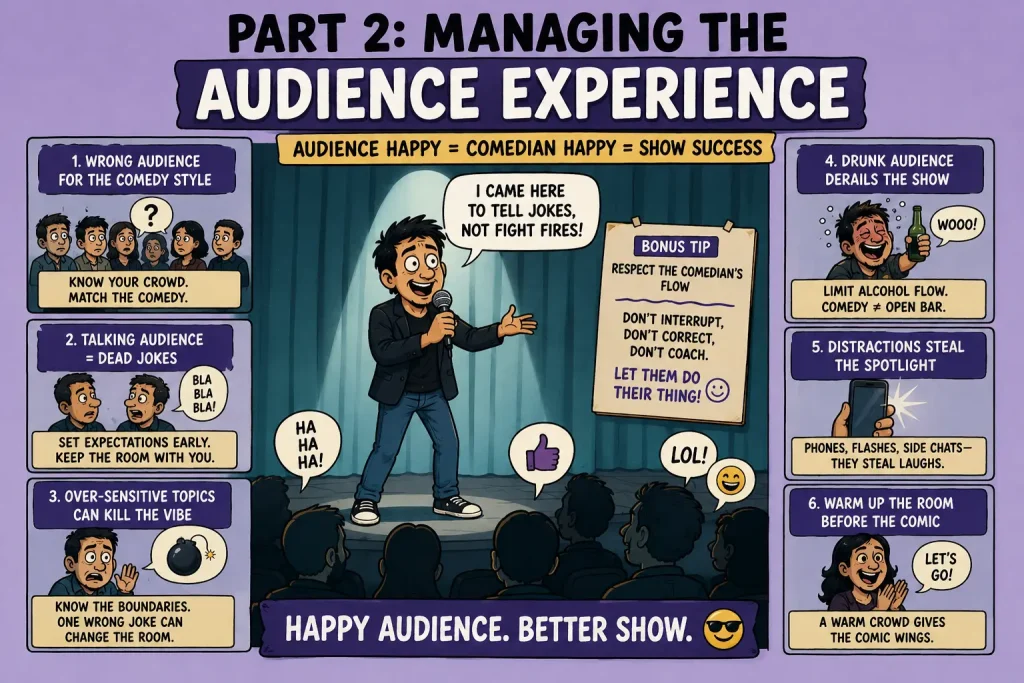
Some of the most memorable comedy show failures have nothing to do with the comedian or the organiser — they come from the room itself. While not every audience-side issue can be controlled, several can be anticipated and minimised.
9. Phones Are the Single Most Preventable Disruption in the Room
A ringing phone breaks a comedian’s rhythm in a way that is disproportionate to how minor the interruption seems. In close seating arrangements, even one phone going off can visibly rattle a performer and pull the rest of the room’s attention away from the stage. A clear, enforced phones-off (or phones-silent) policy at the start of the show is a small ask that prevents a genuinely common disruption.
10. Content Boundaries Should Be Set in the Briefing, Not Discovered Live
Audiences today are more attentive to content boundaries than they have ever been, and that is a planning input, not an obstacle. The organisations and event formats that get this right are the ones that have an honest, specific briefing conversation in advance — covering company context, audience sensitivities, and recent events that should be avoided — rather than leaving a comedian to guess where the lines are. This is precisely the kind of groundwork the
P.U.N.C.H.Y. Framework’s No-Go Zones step is built to handle: a structured conversation that protects both the comedian’s material and the organisation’s reputation.
11. Roast-Style Content Carries Real Reputational Risk
Roast-style comedy, where specific people or groups are the target, draws strong audience reactions in both directions — some find it the highlight of the show, others find it the reason they remember the event for the wrong reasons. For corporate events specifically, this is a content category that needs explicit discussion in the briefing process: who, if anyone, is fair game, and where the line sits. Clear boundaries set in advance prevent the kind of moment that turns into the only thing anyone remembers about the show.
12. Content That Doesn’t Match the Audience Is the Most Common — and Most Avoidable — Mistake on This List
Professional comedians customise their material to their audience’s profile, but that customisation depends entirely on the organiser providing an accurate brief. A set written for a college festival performed at a corporate dinner — or the reverse — falls flat regardless of how funny the material is in the right context. Before finalising a booking, research which comedian’s style genuinely fits your event type, and discuss the boundaries of the material in detail. This is precisely where
clean comedy performers are a safe, reliable choice for mixed-age or conservative corporate audiences — and where engage4more’s team can help match the right comedian to your specific event profile from the start.
13. A Restless or Disruptive Audience Needs Management, Not Just Hope
Not every disruption can be prevented — some audience members are simply disruptive by nature, laughing inappropriately, talking over the performance, or otherwise pulling attention away from the stage. While this can’t be eliminated entirely, a strong venue team, clear front-of-house guidance, and a comedian experienced enough to handle hecklers gracefully all reduce the impact significantly. This is one more reason experience matters when selecting a performer for a high-stakes corporate audience.
A note on alcohol service timing: when a bar opens immediately before a comedy set begins, it can visibly compete for the audience’s attention just as the comedian is trying to establish the room. Several professional comedians, including Dr. Jagdish Chaturvedi, have spoken publicly about this exact challenge. Scheduling the bar to open after the comedy segment — or building in a clear gap — is a simple fix that protects both the audience experience and the performer.
Book Dr. Jagdish Chaturvedi for your corporate event
Part 3: What to Expect From Your Comedian — and How to Set Them Up to Succeed
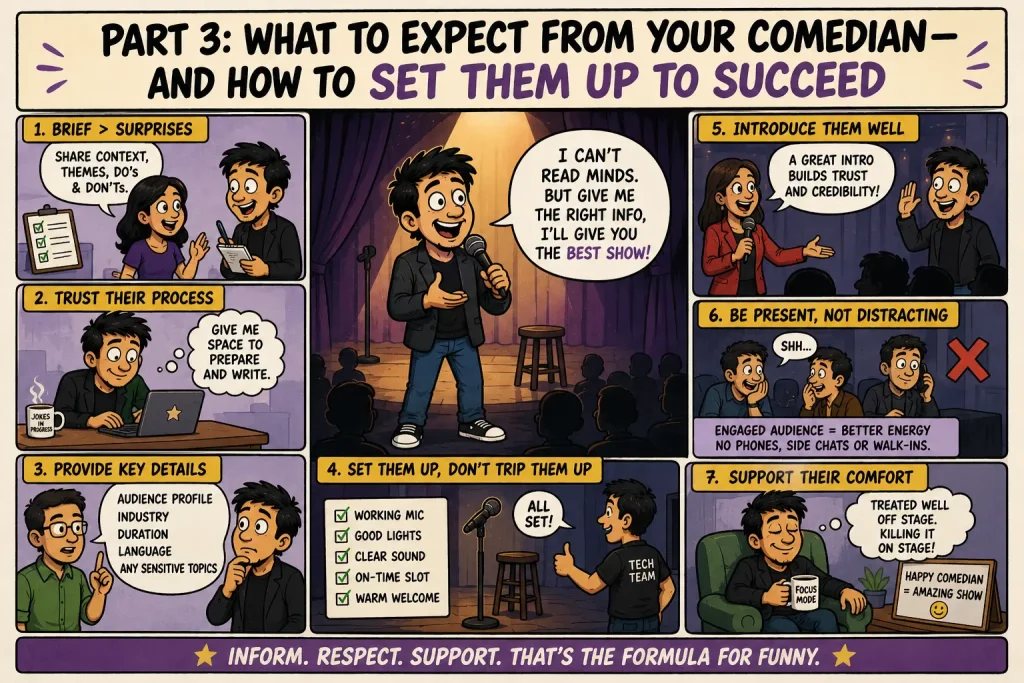
The final category covers what happens on the performer’s side — and what an organiser can do to give a professional comedian the best possible conditions to deliver a great show.
Strong Material Comes From Strong Briefing
A good script is the foundation of any comedy performance, and the most experienced comedians treat scriptwriting as seriously as stage delivery. As an organiser, the most useful thing you can do is provide a genuinely detailed audience brief well in advance — the more specific the input, the more targeted (and funnier) the material. This is exactly the gap the
P.U.N.C.H.Y. Framework closes: a structured briefing process that gives every comedian the input they need to write material that actually lands with your specific audience.
Audience Respect Is Non-Negotiable — and a Good Briefing Prevents It From Becoming an Issue
Professional comedians understand that an audience that feels disrespected stops being an audience and starts being a liability. The best protection against this isn’t hoping the comedian reads the room correctly on the night — it’s giving them clear context in advance about who will be in the room and what the organisation’s tolerance is. This is, again, what a proper No-Go Zones conversation accomplishes before the show, not during it.
Forgotten Lines Happen to Everyone — Experience Is What Makes Recovery Look Effortless
Every comedian, regardless of experience level, occasionally loses their place mid-set. What separates a forgettable moment from a forgettable show is how gracefully the performer recovers — and that recovery ability comes directly from stage experience. When selecting a comedian for a high-stakes corporate event, prior show count and corporate-specific experience are genuinely useful signals, not just vanity metrics.
A Comedian’s Natural Voice Outperforms a Borrowed One
The comedians who consistently deliver for corporate audiences are the ones who have found their own authentic comic voice — whether that’s one-liners, storytelling, high-energy physical comedy, or dry observational humour — rather than performers reaching for a style that isn’t naturally theirs. When evaluating comedians for your event, watch a full set, not just a highlight reel, to get a genuine sense of whether their natural style fits your room.
Every Mistake on This List Is Preventable With the Right Partner
None of the thirteen mistakes above are mysteries. They are the predictable failure points of an unmanaged process — and every one of them is addressed by a structured booking and briefing approach. With over fifteen years and 5,000+ corporate comedy bookings, engage4more has built that process around exactly these failure points.
Every booking begins with an audience profiling conversation — language, age range, sector, event format, and No-Go Zones — followed by a structured briefing with the comedian using our
P.U.N.C.H.Y. Framework, and ends with on-ground coordination so the technical and hospitality side of your event runs the way it should.
Browse the full comedian roster — filterable by style, city, language, and budget — at engage4more’s stand-up comedian hub.
- Clean comedy performers for all-audience corporate events — zero audience-appropriateness risk
- Comedians with corporate backgrounds — material that speaks the audience’s language
- Popular stand-up comedians Emerging comedy stars Budget-friendly options
- Hindi English Female stand-up comedians
- Mumbai Delhi & NCR Bengaluru Chennai
Why Trust engage4more on Comedy Show Planning?
Every mistake in this guide has been seen, fixed, and prevented by the team writing it. This isn’t theoretical event-planning advice — it is fifteen years of operational pattern recognition.
Experience: Nishant Parashar, Founder of engage4more, brings over two decades of high-stakes event management experience — from the operational complexity of the Mumbai Marathon to talent curation for Times of India brand events. engage4more has delivered comedy bookings for over 5,000 corporate organisations.
Expertise: Every category of mistake in this guide — technical, audience, and artist-side — is addressed directly by engage4more’s P.U.N.C.H.Y. Framework, our proprietary six-pillar method for selecting, briefing, and executing corporate comedy that lands. P stands for Personality Fit, U for Unheard Material, N for No-Go Zones, C for Cost Clarity, H for Hook and Flow, Y for the ‘Yes, And’ Rehearsal. It is the direct operational answer to nearly every mistake described above.
Authoritativeness: Our working relationships extend to 500+ active comedians across India. We coordinate hospitality, technical riders, content briefing, and on-ground logistics for every booking — not just the introduction.
Trustworthiness: Our broader ecosystem includes the Good Gobar Show (a podcast celebrating authentic human stories), the Corporate Talent Championship (the world’s largest performing arts talent hunt for corporate employees), and Brain Bout (India’s premier corporate quiz platform). Comedy event execution is not a side service at engage4more — it is core operational expertise built over fifteen years.
Every mistake in this guide is preventable with the right partner.
engage4more’s 15-year track record means your comedy show has already been through everything on this list — and we know exactly how to avoid it. From briefing to hospitality to technical coordination, we handle the details so the only thing your audience remembers is how hard they laughed.
Browse India’s top comedians and book for your event
Clean Comedy Corporate Background Popular Emerging Stars Budget-Friendly Hindi English
Frequently Asked Questions
What should I check before booking a comedian for my corporate event?
Confirm the comedian’s experience with corporate audiences specifically, their language and content style, technical requirements (mic, sound setup), and availability for a pre-show briefing call. The single most important factor is whether their material can be customised to your specific audience — which requires giving them a detailed brief well in advance. Browse comedians filtered by style and corporate experience here.
How do I avoid content mismatch at a corporate comedy show?
Content mismatch — material written for the wrong audience — is the single most common and most preventable mistake on this list. The fix is a detailed pre-show brief covering your audience’s age range, professional background, language preference, and any specific topics to avoid. For organisations that want zero content risk, clean comedy performers are the safest category to start from.
What is the ideal seating arrangement for a corporate comedy show?
Theatre-style seating, with all chairs facing the stage, works best for comedy specifically — it keeps the comedian’s connection with the audience direct and consistent. Round-table seating, while common at corporate dinners, makes it harder for a comedian to engage the room and should be avoided if comedy is the evening’s primary entertainment.
How far in advance should I brief my comedian before the event?
At least one to two weeks before the show, with a single point of contact handling all communication. Briefing a comedian too close to the event — or through multiple uncoordinated stakeholders — produces exactly the kind of confusion this guide warns against. For a complete structured briefing approach, see our guide to the P.U.N.C.H.Y. Framework.
How do I book the right comedian for my corporate event through engage4more?
Share your event brief with the engage4more team — audience size and composition, language, city, date, event format, and budget. The team will provide a curated shortlist of available comedians with indicative fees within 24 hours, along with full coordination on briefing, technical requirements, and hospitality. Start your booking enquiry here.